

Thursday, July 11, 2013


Remembering Mary Surratt: Marylander and Southerner

Some say America and the Constitution died a little with General Lee and the South at Appomattox Courthouse, Virginia in April 1865.
The courtesy and respect shown by General Ulysses S. Grant and his men to General Robert E. Lee and his weary men at the surrender and Lincoln’s wish for a peaceful re-uniting of the North and South would be short lived. The President’s death would be replaced with a bitter hatred by some in the North toward the men and women of the former Confederate States of America.
It has been written that Maryland sided with the Union but the truth is….
The State Legislature of Maryland prepared to vote on secession in 1861 to join the Southern Confederacy but Federal troops were sent to squash their attempt. There is little doubt that many Marylanders resented this attack on their States rights and many were sympathetic to the cause of the South including the Surratt’s who owned a boarding house and tavern. The home to the Surratt’s would be named Surrattsville and today is Clinton.
More @ Huntington News
THE HOOP SKIRT SMUGGLERS

Loudoun and Fauquier Counties, my old stompin' grounds.
In July 1864, four women risked charges of treason to smuggle supplies for Confederate soldiers across the Potomac River. Their story begins on the Maryland-Virginia border in northern Loudoun County, a place of divided loyalties and fierce fighting, and serves to challenge conventional notions regarding nineteenth century women as weak and apolitical.
The climate of war that framed the journey of Elizabeth White, Kate and Betsie Ball, and Annie Hempstone into Union territory to obtain supplies was one of increasing desperation for the Confederacy. The women’s illicit crossing of the Potomac from Virginia to Maryland coincided with a renewed burst of fighting on the border. In July 1864, General Robert E. Lee had ordered General Jubal Early to initiate an attack against Washington D.C., and in tandem with this offensive, Col. John S. Mosby was sent to sever communication lines between Washington and Harpers Ferry. Col. Mosby succeeded in defeating Union forces at their Point of Rocks base on July 5, 1864, and spent the evening dining at the Confederate enclave of Temple Hall. Temple Hall, located north of Leesburg, was the residence of Henry Ball, the father of two sons in the Confederacy.
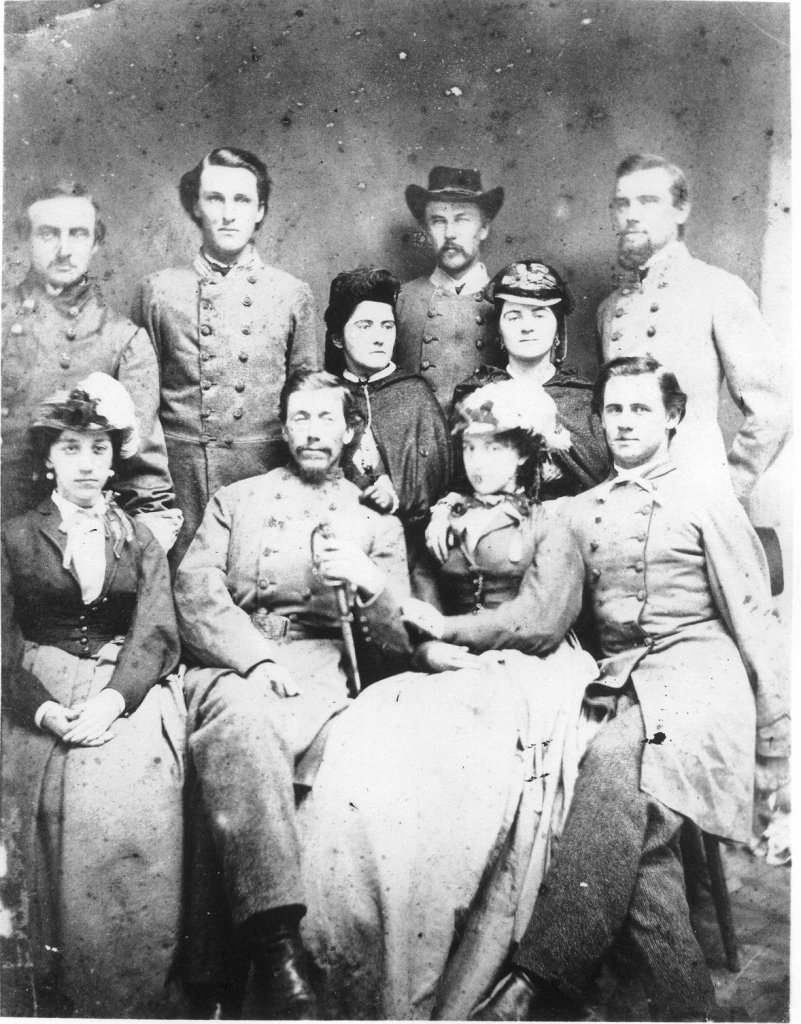
Ball himself briefly fought early in the war and was once imprisoned for refusing to pledge allegiance to the Union. Also living there during this time was Elizabeth White, the wife of Confederate cavalry officer Elijah V. White. Mrs. White was not present at that night’s festivities, however, for on that morning she and three friends had embarked on a daring mission north into Maryland to retrieve supplies for “our dear Maryland boys in grey.” Annie Hempstone later wrote of their adventure as a “little trip across the Potomac,” which belied the true perils of their journey.
More @ Crossroads of War
Morri$ Dee$ - $PLC Fact Sheet
Via Billy

Morris Dees is arguably the most vicious hatemonger in America. There is not enough space here to give you all his repugnant behavior and bigger government views.
"'Til the Cash Comes Flowing Like a River..."
In an article titled Poverty Palace, Morris Dees told journalist John Edgerton that "I had a traditional white Southerner's feeling for segregation."...
"Morris Dees and I [Millard Fuller], from the first day of our partnership, shared one overriding purpose: to make a pile of money. We were not particular about how we did it; we just wanted to be independently rich. During the eight years we worked together we never wavered in that resolve."...
In 1961 when Freedom Riders were beaten by a white mob at a Montgomery bus station, Dees [and Fuller] expressed openly his sympathies and support for what had happened at the bus station.
When one of the men charged with beating the Freedom Riders came to their office for legal representation, Dees and Fuller took the case. The legal fee was paid by the Ku Klux Klan and the White Citizen's Council. [Fuller, Millard. Love in the Mortar Joints. New Century Press: 1980 and The Progressive, July 1988]...
Arrested and removed from court in 1975 for attempting to suborn perjury [bribing a witness] in the Joan Little murder trial in North Carolina....
Morris Dees is arguably the most vicious hatemonger in America. There is not enough space here to give you all his repugnant behavior and bigger government views.
"'Til the Cash Comes Flowing Like a River..."
In an article titled Poverty Palace, Morris Dees told journalist John Edgerton that "I had a traditional white Southerner's feeling for segregation."...
"Morris Dees and I [Millard Fuller], from the first day of our partnership, shared one overriding purpose: to make a pile of money. We were not particular about how we did it; we just wanted to be independently rich. During the eight years we worked together we never wavered in that resolve."...
In 1961 when Freedom Riders were beaten by a white mob at a Montgomery bus station, Dees [and Fuller] expressed openly his sympathies and support for what had happened at the bus station.
When one of the men charged with beating the Freedom Riders came to their office for legal representation, Dees and Fuller took the case. The legal fee was paid by the Ku Klux Klan and the White Citizen's Council. [Fuller, Millard. Love in the Mortar Joints. New Century Press: 1980 and The Progressive, July 1988]...
Arrested and removed from court in 1975 for attempting to suborn perjury [bribing a witness] in the Joan Little murder trial in North Carolina....
More @ Charleston Voice
Tidbits from the Moneychanger

On 11 July 1804 Vice President Aaron Burr mortally wounded former Treasury secretary and inveterate statist Alexander Hamilton in a New Jersey pistol duel. In a match like that, you simply have no idea who to root for.
On 11 July 1864 Confederate Jubal early began a raid that carried him to the gates of Washington, DC. Unhappily, it didn't carry him clean through the gates.
The South an Obstacle to Scientific History


For
the scientific historians of the new American Historical Association in
the mid-1880s and beyond, the American South was one of the greatest
obstacles in the way of changing the way Americans view history. There
were holdouts in the antebellum North as well as Washington Irving, for
example, lived in the days when historians were self-taught and
uncontaminated by the scientific method, yet still managed somehow to
make significant contributions to knowledge and pen useful histories.
Bernhard Thuersam, Chairman
North Carolina War Between the States Sesquicentennial Commission
"Unsurpassed Valor, Courage and Devotion to Liberty"
"The Official Website of the North Carolina WBTS Sesquicentennial"
The South an Obstacle to Scientific History
“On September 9
[1884], in the early afternoon, a small group of college presidents and
professors of history met in . . . the United States Hotel to organize
the new association [and] Dr. Herbert Baxter Adams of the Johns Hopkins
University, moving spirit behind the organization, [was] to act as
secretary. Adams was already making plans to gain federal backing . . .
and he hoped its headquarters would be the capital and its charter
would come from Congress.
But
in spite of Adam’s insistence on “a national association,” the new
organization was far from national in its membership. The West was
represented by Charles Kendall Adams of Michigan, and the South by the
men from Johns Hopkins, native New Englanders. From the time of the
founding of the Association in 1913 . . . Southerners made up a small
percentage of the membership [only 6 percent of a total of 2,843]. Yet,
Southern history and evidence of a concern for history in the South
filled a relatively large number of pages in the Annual Reports and the
American Historical Review.
In
his position as organizer, prime mover and secretary . . . Adams set
the policy . . . to promote the interests of history, but history as
defined by a small group of academically trained historians. Most of
the members were not so trained, and some resented the control by the
college men, as did the novelist–historian Edward Eggleston.
The
task [of the Association] was not a simple one, because the college men
were promoting an approach to history at variance with the main current
of American historiography. Most historians in the United States had
recorded the past of their town or county, State or region, because it
was their locality and they were interested in it and in seeing that its
accomplishments did not go unnoticed.
[The
new scientific historians] implied, and stated, that they had no
interest in the past of a town, State or region for its own sake. They
were only interested in that aspect of a locality’s past that might
throw light upon the general development of an institution, such as town
government, the plantation system, or slavery.
It
was no coincidence that the American Historical Association [AHA] was
established under the wing of the Social Science Association. To the new
historians history was a social science and, they insisted, the very
foundation of all social science. The mission, then, of the Association
was to replace the traditional approach to history with the new
scientific approach.
[Adam’s
saw the importance of gaining recognition for the Association and
stated that] “. . . I have never begun to realize until this year the
importance of corporate influences, of associations of men and money.”
But Adams continued relentlessly, aiming always for the time when
trained historians would cover the country – when their standards would
be the only standards for history and the [AHA] would be not only a
truly national, but a truly professional organization.
But
[the greatest] obstacle to the new history was the fact that the South
already had a well-established historical tradition . . . [and] a rich
historical literature. The South not only lived in history, it lived on
history. History served the Southern States as God served New England.
Every aristocratic Southerner knew his family tree . . . Most people of
the South knew that American history started with the settlement of
Virginia, not with the landing of the Pilgrims . . .
There
was no dearth of history or of historical interest in the Southern
States, but it was not the kind that the new scholars could accept. This
history emphasized the uniqueness of place and people, and its truth
was sought not in musty-smelling manuscripts and dead documents, but in
living tradition and vivid intuition.
The
first meeting was dominated by men of the Northeast. In 1889 . . . at
the sixth meeting . . . Southern history for the first time was
recognized as a separate field of study for the new science. The first
session on Southern history convened Tuesday morning, December 31 [and the first of five papers was an] essay on Bacon’s Rebellion. It was not on Southern history.
The
great mission of the new Southern scholars [of the AHA] was to cut
loose from traditional history and examine the Southern past
impartially, to discover its true role in national development. None of
the new scholars wrote as a native of a Southern State, but “from the
point of view of an American who is at the same time a Southerner, proud
enough of his own section to admit its faults, and yet to proclaim its
essential greatness.”
All
professional practitioners denounced quackery in history through the
medium of their Association, just as the doctors were doing through the
American Medical Association. The work of Southern [scientific]
historians, [even though it undermined the traditional Northern
interpretation of American history], was accepted because it was done
with the new technique and the approach of the new history.”
(The
American Historical Association, David D. Van Tassel, Journal of
Southern History, Volume XXIII, No. 4, November 1957, pp. 465-473,
481-482)
Only 1 percent of “terrorists” caught by the FBI are real
Via avordvet

Proponents of this
build-up argue that it’s made us safer. They point to hundreds of foiled
plots to make their case. But Trevor Aaronson, author of The Terror Factory: Inside the FBI’s Manufactured War on Terrorism, dug into these supposedly dastardly plots and found that they are much less than meets the eye.
Aaronson recently appeared on the AlterNet Radio Hour. Below is a lightly edited transcript of the discussion.
Joshua Holland: Trevor, the raw statistical data say that Americans have a significantly better chance of being struck dead by lightning than of being killed in a terrorist attack here at home. It’s obviously different for people in some other countries.
I got that from the official terrorism statistics put out by the FBI and other related agencies. And they also track foiled attacks. These law enforcement agencies say that these foiled attacks prove that they are saving American lives. How would you respond to that?
Trevor Aaronson: I’d say that the majority of the foiled attacks that they cite are really only foiled attacks because the FBI made the attack possible, and most of the people who are caught in these so-called foiled attacks are caught through sting operations that use either an undercover FBI agent or informant posing as some sort of Al-Qaeda operative.
In all of these cases, the defendants, or the would-be terrorists, are people who at best have a vague idea that they want to commit some sort of violent act or some sort of act of terrorism but have no means on their own. They don’t have weapons. They don’t have connections with any international terrorist groups.
"The Terror Factory" author Trevor Aaronson exposes the Bureau's undercover sting operations for the farce they are
In the dozen years since the 9/11 attacks, we’ve watched as
a classified new legal regime for government surveillance has been
hashed out, local police forces have become heavily armed military-type
units and a whole new layer of bureaucracy has hatched to provide us
with an abundance of “homeland security.”
Aaronson recently appeared on the AlterNet Radio Hour. Below is a lightly edited transcript of the discussion.
Joshua Holland: Trevor, the raw statistical data say that Americans have a significantly better chance of being struck dead by lightning than of being killed in a terrorist attack here at home. It’s obviously different for people in some other countries.
I got that from the official terrorism statistics put out by the FBI and other related agencies. And they also track foiled attacks. These law enforcement agencies say that these foiled attacks prove that they are saving American lives. How would you respond to that?
Trevor Aaronson: I’d say that the majority of the foiled attacks that they cite are really only foiled attacks because the FBI made the attack possible, and most of the people who are caught in these so-called foiled attacks are caught through sting operations that use either an undercover FBI agent or informant posing as some sort of Al-Qaeda operative.
In all of these cases, the defendants, or the would-be terrorists, are people who at best have a vague idea that they want to commit some sort of violent act or some sort of act of terrorism but have no means on their own. They don’t have weapons. They don’t have connections with any international terrorist groups.
More @ Salon
Ohio school district will allow teachers to carry guns starting this fall
Via Freedom Outpost

An Ohio school district has announced that it will implement a program that will allow teachers to carry guns on campus in a designated school safety zone.
According to a local news report, the board of education recently approved the new school safety plan for the Newcomerstown Exempted Village School District, a small rural school district located about 100 miles south of Cleveland, with just over 1,000 students.
The policy change will take effect in the fall of the 2013-2014 school year, and although the change has made news, the idea is nothing new.
“This is a discussion we’ve had for a long time. We’ve been very transparent. We want to keep our students safe,” said Superintendent Jeff Staggs. However, just because the discussion has been transparent doesn’t mean the details of the program are, which Staggs admits is part of the intent.
School board president Jerry Lahmers explained that it would be counterproductive to release too many specifics of the program, such as the number of people carrying firearms or which buildings they occupy.
An Ohio school district has announced that it will implement a program that will allow teachers to carry guns on campus in a designated school safety zone.
According to a local news report, the board of education recently approved the new school safety plan for the Newcomerstown Exempted Village School District, a small rural school district located about 100 miles south of Cleveland, with just over 1,000 students.
The policy change will take effect in the fall of the 2013-2014 school year, and although the change has made news, the idea is nothing new.
“This is a discussion we’ve had for a long time. We’ve been very transparent. We want to keep our students safe,” said Superintendent Jeff Staggs. However, just because the discussion has been transparent doesn’t mean the details of the program are, which Staggs admits is part of the intent.
School board president Jerry Lahmers explained that it would be counterproductive to release too many specifics of the program, such as the number of people carrying firearms or which buildings they occupy.
More @ GUNS
Man swims 5 hours to save his family
Via Freedom Outpost

Emily Horn, 9, was among those saved from a capsized boat.
John Franklin Riggs left family members clinging to a capsized boat
and for their lives in a sea of stinging jellyfish, swimming miles and
climbing rocks at the shoreline in pitch blackness to reach help at the
first house he saw.
Thank goodness somebody answered the door.
“He came to the right house,” said Angela Byrd, whose dog’s barking awakened her quiet house in Chance at about 1 a.m. Wednesday morning. There stood Riggs, soaking wet and barefoot.
“He said, ‘I’ve been swimming since sundown; I need help,’ ” she said.
Emily Horn, 9, was among those saved from a capsized boat.
Absolutely amazing.
Thank goodness somebody answered the door.
“He came to the right house,” said Angela Byrd, whose dog’s barking awakened her quiet house in Chance at about 1 a.m. Wednesday morning. There stood Riggs, soaking wet and barefoot.
“He said, ‘I’ve been swimming since sundown; I need help,’ ” she said.
More @ Delmarva Now
Subscribe to:
Posts (Atom)