Sunday, April 17, 2016

Southern Honour and Southern History

 robert e lee 2

In present day academia, one is guaranteed a celebrated career by inventing a new way to put the South in a bad light or a new twist on an old put-down. In the 1970s, Raimondo Luraghi, Eugene Genovese, and other historians were starting to pay some attention to the existence of a genuine aristocratic ethics in the Old South. Immediately a C. Vann Woodward student stepped into the breach and produced a book on “Southern Honor.” Now we would suppose that a book on Southern honor would have something to say about George Washington and Robert E. Lee and devotion to duty. Not a bit of it. “Southern honor,” it seems, is just a dishonest excuse for some backward folks in East Tennessee to suppress their non-comforming neighbours. Honour in the South is not what Jacob Burkhardt defined as an enigmatic mixture of ethics and ego; it is all about brawls and peasant chivarees. This same historian a few years later essayed a presentation on how Confederate soldiers were not really brave. A graduate student who actually knew something about the subject politely took him apart limb by limb.

What Is Wrong With America?

What Lincoln Accomplished

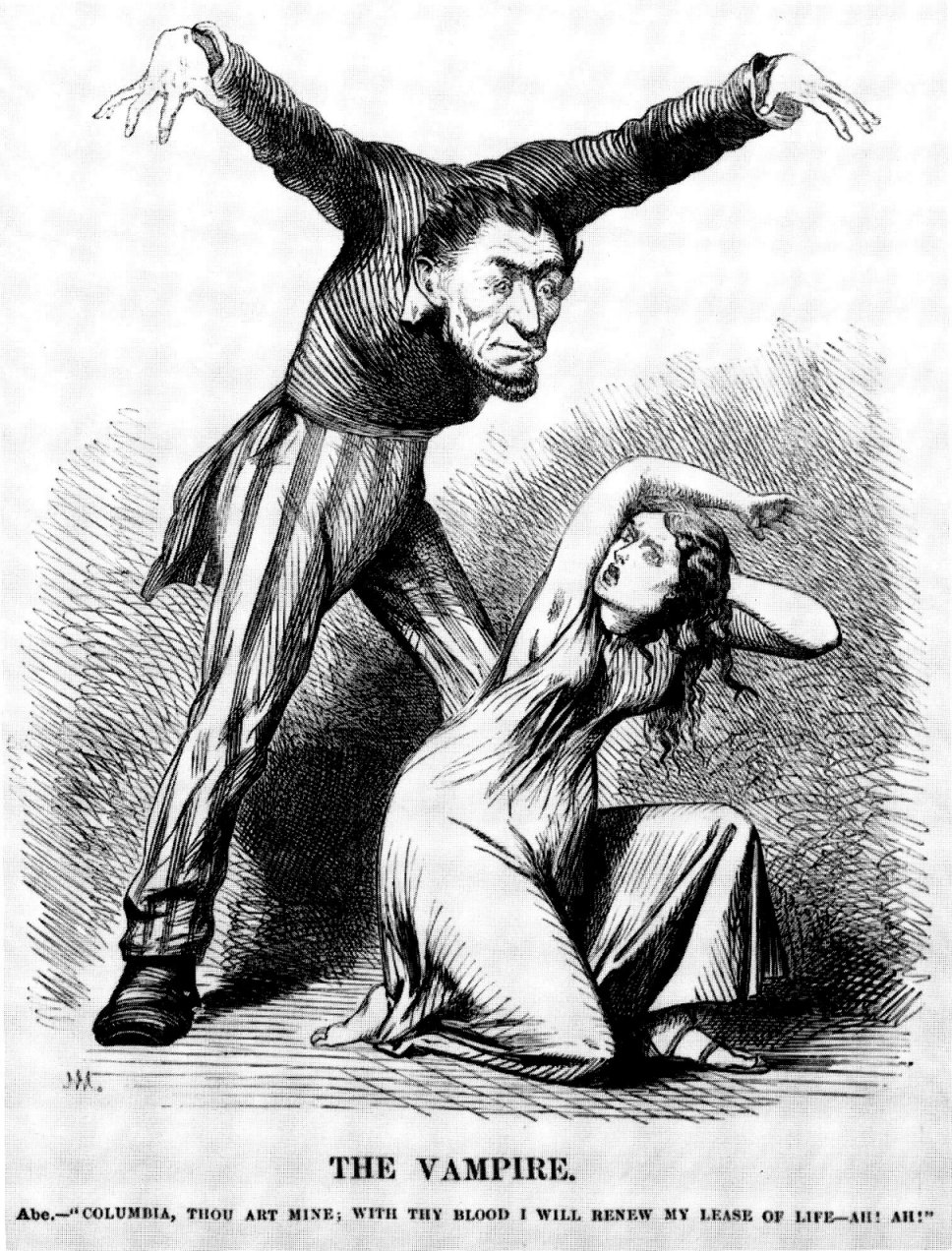
https://bperet.files.wordpress.com/2015/10/017_matt_morgan_comic_news_11_26_1864_vampire_lincoln.jpg

“The world claims now, and rightly, that Lincoln made the United States of America a “government of the people, by the people and for the people.” Lincoln found the United States of America a government of the States, by the States and for the States. He changed it by force of a four-year war into a nation.

Up to 1861, the Federal government was a republic of sovereign States of such wisdom and power as to win the respect and love of all true lovers of political liberty, but too wise and not powerful enough to coerce sovereign States.

Now, since 1861, we are a nation with sovereign States reduced to provinces, State rights gone (for what rights have they who dare not strike for them?); a nation, admired still by the world, but feared and mistrusted as a nation boastful and overbearing, ready and willing to regulate, if not to rule, the world like old Rome. O what a fall was there, my countrymen!”

(What Lincoln Accomplished, Berkeley Minor, Charlottesville, VA, Confederate Veteran, September 1926, page 324)

Ronnie Davis, Injured in PDRA Spring Nationals, Passes Away

Whether in a full bodied stock car, open wheel race machine or a high powered drag car, any driver who slips behind the wheel each week is well aware of the risks associated with the sport that they love.

While the families, friends and fans of these drivers never hope that they will have to witness the day that their favorite drivers will either be unable to compete or otherwise, there are those times when we have utter the words…“So long my friend”.

More @ Racing Junk

 Ronnie Davis, PDRA Spring Nationals

2016 Nomination SuperPacs: Who has bought whom so far?

Via John


Donald Trump Is Outperforming Ted Cruz, Bernie Sanders AND Hillary Clinton

Via Billy

Delegate Count 4-17 Rep

Donald Trump is not only outperforming Ted Cruz in the election to date, he also outperforms Democrats Hillary Clinton and Bernie Sanders as well.

The election results to date (as of Sunday April 17th) show that Trump outshines all the candidates.

Donald Trump has:
** More primary wins (17)
** More overall state wins (20)
** The highest percentage of primary wins (81%)
** The highest percent of overall state wins (63%)
** The highest percent of primary delegates (65%)
** The highest percent of overall delegates (58%)
** And Trump ties Hillary for the highest percent of overall votes (57%).

Donald Trump Warns RNC: Straighten up or Going to be a Rough July

Via Billy

Communists and Muslims turn Paris into a war zone

Via WRSA

 
It all happened on April 14, just two days ago in Paris. Between the destructive force of socialists communists and migrants, the once-beautiful city appears to be doomed if nothing changes. A brutal battle among migrant groups was caught on film by terrified residents, while on the same day students and workers led by labor unions continued their ongoing battle against extremely limited labor reforms proposed by the socialist government, leading to violence and arrests.

More @ New Zeal


Sheridan Hastens the Indians’ Demise


 Native American S/B American Indian

Grant, Sherman and Sheridan applied the same hard hand of war used on the American South to the Plains Indians. Northern Gen. Phil Sheridan endorsed the slaughter of western buffalo herds as a way to subjugate the Indians and break their will to fight – the same as he had done earlier in the Shenandoah Valley. Notably, one of the most successful western hunters was “New England Yankee Josiah W. Mooar, who killed nearly 21,000 buffalo in three years . . .”
Bernhard Thuersam, www.Circa1865.com   The Great American Political Divide

Sheridan Hastens the Indians’ Demise

“At the same time they were going hungry [on reservations], the Indians watched with impotent disgust as growing numbers of white hunters set up their forked rifle sticks on ancestral hunting grounds and slew the animals in staggering numbers with their .50 caliber Sharps buffalo guns.

In 1872-73 alone, 1,250,000 hides were shipped east to fashionable furriers. By the end of 1874, an estimated 4,373,730 buffalo had been slain, of which a grand total of 150,000 had been taken by the Indians.

The hunters’ intrusion on tribal lands was patently illegal, but the army did little to stop it. Despite the Medicine Lodge Treaty, which had outlawed white intrusion on Indian land, the unofficial attitude of the government toward the hunters was one of de facto cooperation.

Secretary Columbus Delano, whose department was charged with looking out for the Indian’s welfare, stated bluntly in his annual report, “I would not seriously regret the total disappearance of the buffalo from our western prairies, in its effects upon the Indians, regarding it as a means of hastening their sense of dependence upon the products of the soil.”

Sheridan, who had rather less confidence in the farming capabilities of the Indians, nevertheless looked upon the slaughter of the buffalo as an effective means of subjugating the tribes and breaking their wills.

When the Texas legislature briefly considered passing a bill outlawing buffalo poaching on native lands, Sheridan made a personal appearance before the lawmakers in Austin. Rather than penalize the hunters, he said, the legislature ought to give them each a medal, engraved with a dead buffalo on one side and a discouraged-looking Indian on the other.

In an attempt to keep closer watch on the wide-ranging Sioux, Sheridan received permission from Grant in late 1873 to mount an expedition into the Black Hills to scout locations for a new fort in the area. Custer and the Seventh Cavalry spent the better part of eight weeks exploring the sacred territory. As usual, Custer turned the expedition into a combination picnic, big-game hunt, and public relations extravaganza, sending back glowing reports of the region’s vast animal and mineral resources.

Injudiciously, he also fanned the flames of public greed by claiming, with some exaggeration, that pieces of gold could be plucked up from the very ground one walked on. At the first mention of gold, hundreds, then thousands, of ears pricked up. It was, after all, the Gilded Age, and fortune-making was the national sport.

[Though the 1868 treaty with the Sioux] “virtually deeds this portion of the Black Hills to the Sioux,” [Sheridan suggested] that miners and homesteaders try their luck further west in the unceded lands of Wyoming and Montana. The Sioux had hunting rights there, too, but Sheridan hoped to nullify these rights by encouraging the further depopulation of buffalo and other game. When there was nothing left to hunt, he reasoned, the Indians would have no more hunting rights to lose. Needless to say, the Sioux were unamused by this line of reasoning.”

(Sheridan: The Life and Times of General Phil Sheridan, Roy Morris, Jr., Crown Publishers, 1992, pp. 342-343; 348-349)

Lincoln a Talented Farmer and Stump Speaker

http://euro-synergies.hautetfort.com/media/01/00/1417239820.jpg

British public opinion of the North’s war upon the South was informed by their newspapers. The conservative London Dispatch viewed the true motives of the war as “the continuance in power of the North to tax the industry of the South and the consolidation of a huge confederation to sweep every other power from the American continent, to enter into the politics of Europe with a Republican propaganda, and to bully the world.”
Bernhard Thuersam, www.Circa1865.com   The Great American Political Divide

Lincoln a Talented Farmer and Stump Speaker

“The British aristocrats’ negative view of the U.S. system of government was enhanced by their negative reaction to Abraham Lincoln as president. His immediate predecessors – [Franklin] Pierce and [James] Buchanan – had had backgrounds that seemed familiar to those of British cabinet ministers. Pierce had been a congressman, a major-general in the Mexican War, and a senator while Buchanan had been a senator, secretary of state, and minister to Britain.

But in 1860 the nation had elected a man from the frontier whose only experience in the national government was a single two-year term in Congress.

The British minister in Washington, Lord Lyons, reported in May 1860 that the Republican nominee for president was “a rough Westerner, of the lowest origins and little education.” Two months later he still referred to Lincoln as a “rough farmer who began life as a farm laborer and got on by a talent for stump speaking.”

British journalists who met the president in 1861 and 1862 emphasized his rustic and ungainly appearance. Edward Dicey, correspondent for the Spectator and Macmillan’s Magazine, wrote a similar description in 1862 and added that “you would never say he was a gentleman.”

[Dicey] wrote that Lincoln “works hard . . . does little, and unites a painful sense of responsibility to a still more painful sense, perhaps, that his work is too great for him to grapple with.” Alexander J. Beresford-Hope, a wealthy ultraconservative, remarked that “nobody in this county, clever as he might be at rail-slitting, at navigating a barge, or at an attorney’s desk, would, without other qualifications, ever become prime minister of England, let alone county court judge.”

Richard Cobden, an important Radical leader in Parliament and a stout friend of the North, thought . . . [after] the emancipation proclamation [that] “Lincoln had a certain moral dignity, but is intellectually inferior.” A London correspondent reported to Die Presse in Vienna that Lincoln was “a plebian, who made his way from rail splitter to representative in Illinois, a man without intellectual brilliance, without special strength of character, not exceptionally impressive – an ordinary man of goodwill.” The correspondent’s name was Karl Marx.

A British scholar, Martin Crawford, described the [London Times] persistent belief that the North could not win the war and that continued separation of North and South was inevitable:

“The longer the [war] lasted, the more convinced The Times became that Lincoln’s government should accept disunion for what it was, a sad and irrevocable fact . . . Britain’s leading newspaper had established itself as a committed opponent of the [Northern] cause . . . “

(One War at a Time, The International Dimensions of the American Civil War, Dean B. Mahin, Brassey’s, 1999, pp. 28-29)