
Wednesday, March 13, 2019


Comment on Everything You Know About the Civil War (sic) is Wrong
Via David
To secede from the Union over Tariffs, when Congress had the constitutional right to collect Tariffs, would in fact be unconstitutional and an act of rebellion. So. To be smart and legal about it they simply followed the lead of Northern states. Slavery along with the tariff was also constitutional… and so was the federal Fugitive Slave Law. However, under the 10th Amendment and States Rights, Northern states were nullifying the Federal Fugitive Slave Law and refusing to return runaway slaves. So. If the Northern States could claim States Rights and disobey the US Constitution… so could the Southern States for this very same reason. That’s why they listed States Rights and slavery as their reason for seceding. Then. At this point, Lincoln offered the South the Corwin Amendment that would forever make slavery constitutional and legal to where no amendment could ever abolish it. (Yeah. The Great Emancipator). All the South had to do was rejoin the Union and pay the high Tariff being placed on them. The South refused and Lincoln had them invaded. While this was going on. Lincoln and his Union Yankee army was murdering the Indian out West, enslaving them and taking their land. Neither the invasion on his brothers in the South, or the invasion of the Indian in the West was over slavery. It was over money, banking, and power. Period. Because of Lincoln. We ended up with another Centralized banking system.. the Federal Reserve and IRS… taxes on our income. Now everyone in the entire damn country are debt slaves. Study the economy issue. Follow the money and you will see the true cause of the invasions in both the South and the West.. It wasn’t slavery.
--Jim Hays
--Jim Hays
No More Surrender
Via Bob

Well, the day of my uncle's funeral, six months after my double bypass, we were feeding the pigs that night, which we had done every night for a year or two. The male pig decided he wanted to get a little aggressive. His weight was around 250 pounds, fully grown. I felt a nudge on the back of my leg, then I felt a nudge again, a hard nudge, which is not really uncommon, our pigs just did that. But on the third nudge, I realized he was biting me about knee high. I hollered at him and he started to circle me.
Being the prepared person I am, I pulled out my pistol and fired a shot into the ground in front of him. This did not deter him, he continued to circle. It was still daylight at this time and I knew what was coming, so I shot him right behind the head, which ended the circling.
Well, the day of my uncle's funeral, six months after my double bypass, we were feeding the pigs that night, which we had done every night for a year or two. The male pig decided he wanted to get a little aggressive. His weight was around 250 pounds, fully grown. I felt a nudge on the back of my leg, then I felt a nudge again, a hard nudge, which is not really uncommon, our pigs just did that. But on the third nudge, I realized he was biting me about knee high. I hollered at him and he started to circle me.
Being the prepared person I am, I pulled out my pistol and fired a shot into the ground in front of him. This did not deter him, he continued to circle. It was still daylight at this time and I knew what was coming, so I shot him right behind the head, which ended the circling.
More @ Frank & Fern
$outhern Poverty Center Surpasses Half Billion in Assets; $121 Million Now Offshore - Top money-maker in the outrage industry

Reports $518 million in total assets despite $21 million fall in donations
The Southern Poverty Law Center (SPLC), a far-left nonprofit known for its "hate group" designations, has surpassed a half billion dollars in total assets and now has $121 million parked offshore, according to the group's most recent financial statements.
The SPLC, which is based in Montgomery, Ala., has not publicly posted its most recent financial statements on its website. However, the organization applied for renewal in the state of California days ago and submitted a number of documents pertaining to its financial standing including its most recent audited statement and tax forms for calendar year 2018, which covers Nov. 1, 2017 to Oct. 31, 2018.
More @ The Daily Wire
In our hearts, unconquered still

I recited the poem many time as a boy, heartfelt and loved.
The Conquered Banner
Federalism was suffocated at Appomattox and we live with the results today. Yes, history can be re-written, and it's spawn is ignorance as fed by the public school system on this and any other subject we care to uncover- sincere apologies to the many dedicated teachers but the results speak for themselves and the issue is out of your hands entirely. The statues mean very different things to us today than when they were dedicated, partly because we did not live through the events and partly because as a public we are unschooled on the precedents and aftermath. So yes, the statues are not appropriate in today's social beehive so pluck them out as you might your offending eye.
Without the slave-produced raw materials (King Cotton) the mills of the north would go wanting. The material costs would skyrocket ruining the market for their products; the New England and New York mill owners were as much at fault as anyone. This is a flawed and too simplistic explanation but serves to reveal that the South's production was not for it's own use as is popularly believed (the plantations did not grow peas and carrots as cash crops), but sent as raw material to Britain and New England, heavily tarriffed if I remember correctly, and it was those tariffs that Lincoln sought to protect by opposing the Confederate secession, not protection of the enslaved Africans.
I have not included all the elements of error in this quick post, so forgive my incomplete assessment. The blindness of current society to history is appalling and will contribute to the coming social disaster; the rush to blame today's ills on an inanimate and mute talisman is not only juvenile and misdirected, but siphons the energy from other fruitful efforts. I can see how a stunted mind could focus on convenient targets to create an enemy for their ire (think of the Salem witch hunts and the Monty Python send-up to illustrate that point), but an adult with a fully formed mind should be willing and able to search for the truth rather than cling to myth and superstition, but recent trends defy that theory.
The Good Boy Mayor stated the removal was "...for public safety" among other tripe. What? Isn't that why we have the police department and sheriff's office? No? Well, Good Boy Mayor what the hell else is for public safety? My firearms, bumper stickers, refrigerator magnets?
We are living under mob rule. Don't believe it? Try going against the prevailing group-think in a public place.
Someone, maybe on this site, said "We are an embarrassment to our ancestors" and they are correct.
--Dan Patterson
Wolf dog dumped at Kill Shelter

Many Thousands Gone & The Slave Trade
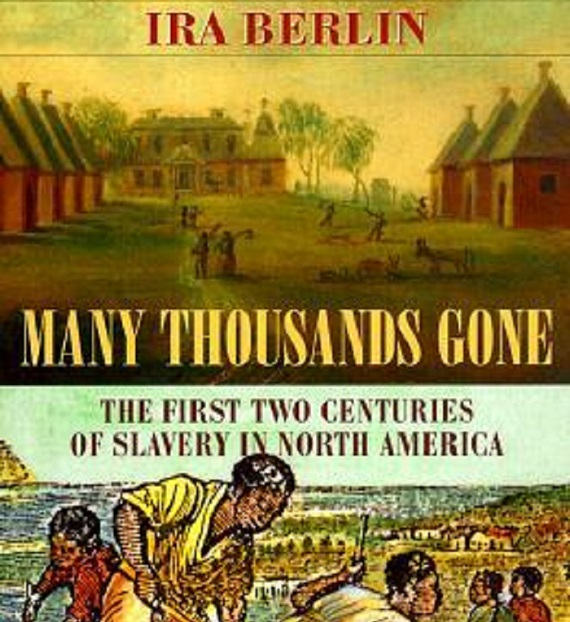
A review of Many Thousands Gone: The First Two Centuries of Slavery in North America (Harvard, 1998) by Ira Berlin
For an understanding of the Atlantic-African slave trades and the origins of the peculiar institution in North America, Prof. Berlin’s Many Thousands Gone is a must read (along with Hugh Thomas’ The Slave Trade: The Story of the Atlantic Slave Trade, 1440-1870 [1997] ). An expert in African-American history at the U. of Maryland and long-time editor of Freedom: A Documentary History of Emancipation, 1861-1867 ( 4 vols., 1982-1993), Berlin brings to the task of explaining what today seems impossible to imagine his own considerable talents as a(n)historian and a welcome objectivity.
The answers he provides are thus more nuanced and perhaps not as satisfying as some would like to hear. “New World slavery,” he notes, “did not have its origins in a conspiracy to dishonor, shame, brutalize, or reduce slaves on some perverse scale of humanity-although it did all of these at one time or another….” At bottom, and the root of it all, was greed on the part of all involved (African, European, and Muslim) who sought wealth for personal and for imperial reasons.
More @ The Abbeville Institute
******************
The truth is not difficult to find, and it is that a Portuguese ship brought the first African to North America, and well after the Spanish had brought them, already enslaved by their African brethren, to the islands of the Caribbean – the latter done after it was found that the local Indians they had enslaved for work died off too quickly.
The British fostered the rise and perpetuation of African slavery in America as a colonial labor system – and African chieftains supplied their needs with captured men, women and children.
The New Englanders quickly followed the British example and became preeminent slavers in their own right, with the economic base of that region founded on slave trade profits, and the later mills of Massachusetts dependent upon slave-produced cotton for profitability.
The American South fought no more fought to preserve slavery than did the American Colonies after Lord Dunmore’s infamous emancipation proclamation of 1775; nor was the United States fighting for the preservation of slavery after Vice Admiral Sir Alexander Cochrane issued his own emancipation proclamation in 1814.
The American South fought for political independence from a North which had lost its moorings to the Constitution of 1789 which held the States together. The South had remained faithful to that document, and departed that federation to maintain its political liberty. The North prosecuted a devastating war to prevent that political liberty, “freed” the slaves which they themselves had helped securely fasten upon the South, and converted them into a dependable voting bloc with which to maintain political hegemony over formerly free States.
Bernhard Thuersam, www.Circa1865.org The Great American Political Divide
The Slave Trade
“In the library of the State College at Raleigh, N.C., there is a notable book of some three hundred and fifty pages and forty-nine illustrations – the fifteenth publication of the Marine Research Society, of Salem, Mass., and published in Vermont – the title being: “Slave Ships and Slaving.” The introduction is written by a British navy officer, and the text is by George F. Dow.
Within ten years after the discovery of America the Spaniards began to transport Africans to work in their possessions, and all the maritime nations of Europe followed their example; and during the next two hundred and fifty years the English transported twice as many as all other countries put together. They began in Queen Elizabeth’s time, kept it up in the next reign, and, in 1662, the Duke of York undertook to transport to the British Colonies three thousand slaves every year. Ten years later the King himself became interested and, under contract, England got from Spain the exclusive right to supply the Spanish colonies [with African slaves]; and the King of England and the King of Spain each received one-fourth of the profits.
Between 1680 and 1688 England had two hundred and forty-nine slave ships; from 1713, for twenty years, 15,000 slaves were annually brought to America. In 1786, England brought over 97,000 slaves. During eleven years, 1783-1793, Liverpool owned eight hundred and seventy eight vessels in this trade, and imported many thousands of slaves in the West Indies. They were worth some 15,000,000 pounds of that period; equal to about $150,000,000 now [1930].
While Liverpool was the chief port for this trade, Bristol was a close second. Then, over here, New England was not slow. Massachusetts started in 1638. However, Rhode Island became the rival of Liverpool. Ten pages on this volume are devoted to the operations in Rhode Island. There nearly everyone was interested.
In 1750, “Rum was the chief manufacture of New England. About 15,000 hogsheads of molasses were annually converted into rum in Massachusetts alone. The number of stills in operation was almost beyond belief. In Newport there were no less than twenty-two.” With rum they purchased Negroes in Africa; these were exchanged for molasses in the Caribbean Islands and South America, and the molasses was brought to the New England stills; and so the profitable business was carried on in a circle to an extent beyond ordinary imagination!
It was the very basis of New England’s prosperity. At Newport, Bristol and Providence [Rhode Island], some of the most respectable and wealthy merchants were engaged in the trade. Even preachers and philanthropists were advocates. “One elder, whose ventures in slaving had usually turned out well, always returned thanks on the Sunday following the arrival of a slaver that the Africans could enjoy the blessing of a Gospel dispensation.”
The Southern colonies had no ships, nor any molasses. They were not in the trade. However, the British Slaving Company, in which the King of England was a partner was in duty-bound to supply the needs of the colonies as particularly required by Good Queen Anne. The Colonies were forbidden to manufacture, and their products were required to be shipped to England, where they were exchanged for British goods. So the more slaves making products, the more goods the Colonies bought in England.
At length Virginia forbade any more importation [of Africans] but the King annulled that Virginia law. In Jefferson’s draught of the Declaration of Independence he denounced the King most severely for annulling these prohibitions. However, in 1774, importations were forbidden by the people of North and South Carolina, and there were no importations until 1803, when South Carolina opened her ports for four years.
Great Britain abolished the [slave] trade in 1807, just as the Congress of the United States did. After a few years, other countries followed our example: Spain in 1820, Portugal in 1830; but the trade between Portuguese Africa and Brazil did not cease until Brazil, in 1888, put a stop to it. That this volume has been prepared by the Marine Research Society, of Salem, Mass., speaks well for New England, and it should be in every library of the South.”
(The Slave Trade, Capt. S.A. Ashe, Confederate Veteran, December 1930, pg. 457)
More than half of all illegal immigrants arrested at the US-Canada border are Mexican
More than half of the illegal immigrants arrested last year as they traveled from Canada to the U.S. were Mexican citizens, according to newly released government data.
A total of 4,316 noncitizens were arrested at the northern U.S. border in fiscal 2018, and 2,245 of those were Mexican citizens. Mexican nationals are able to fly to Canada without a visa.
More @ Washington Examiner
Leaked Lisa Page Testimony Reveals FBI Was Considering Charging Crooked Hillary under Espionage Act Until DOJ Told Them “No”

On Friday Republican Doug Collins (R-GA) released the Bruce Ohr testimony transcript online.
Rep Collins said his patience with the DOJ had grown thin so he released the testimony.
Collins plans on releasing more testimony.
The Ohr testimony disclosed the Bruce Ohr gave his wife’s opposition research on Trump to the FBI in a flash drive.
On Tuesday Doug Collins released the Lisa Page testimony online.
More @ The Gateway Pundit
Subscribe to:
Posts (Atom)