Thursday, December 27, 2012

Strict gun laws in Great Britain and Australia haven't made their people noticeably safer, nor have they prevented massacres.

Via wanusmaximus


After a school massacre, the U.K. banned handguns in 1998. A decade later, handgun crime had doubled.

Americans are determined that massacres such as happened in Newtown, Conn., never happen again. But how? Many advocate more effective treatment of mentally-ill people or armed protection in so-called gun-free zones. Many others demand stricter control of firearms.

We aren't alone in facing this problem. Great Britain and Australia, for example, suffered mass shootings in the 1980s and 1990s. Both countries had very stringent gun laws when they occurred. Nevertheless, both decided that even stricter control of guns was the answer. Their experiences can be instructive.

In 1987, Michael Ryan went on a shooting spree in his small town of Hungerford, England, killing 16 people (including his mother) and wounding another 14 before shooting himself. Since the public was unarmed—as were the police—Ryan wandered the streets for eight hours with two semiautomatic rifles and a handgun before anyone with a firearm was able to come to the rescue.

Nine years later, in March 1996, Thomas Hamilton, a man known to be mentally unstable, walked into a primary school in the Scottish town of Dunblane and shot 16 young children and their teacher. He wounded 10 other children and three other teachers before taking his own life.

More @ WSJ

Oh, By The Way

Via Tom

VERBATIM 

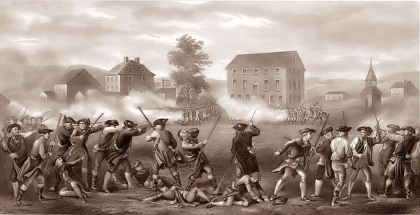
Pretty sure American History isn’t being taught today the same as way back when my generation had to learn that stuff.  So here it is, in one lesson, just so we all know what we’re talking about.


Remember the Battle of Lexington, where the seventy Minutemen of Captain Parker met the 800 man advance guard of Major Pitcairn, and the “shot heard ’round the world” took place in that early morning in April 1775?   Well, that was all about gun confiscation. 


 There, now don’t that make you feel a whole lot better?


revolutionary-war-minutemen

Decide by Dec. 31 Whether to Stay in Medicare, Societies Say

Via Hype And Fail 


As the threat of a massive cut in Medicare reimbursement on January 1 becomes more real, 2 medical societies are reminding their members that they have until December 31 to decide how they want to participate in the program — if at all — next year.

The American Academy of Family Physicians (AAFP) and the American College of Physicians (ACP) are not suggesting that physicians bail out of Medicare. Their guidance, recently posted on their Web sites, merely states that physicians should know their options.

However, organized medicine has repeatedly warned Congress that if it fails to avert a huge cut in Medicare pay, droves of physicians would quit the program, leaving many seniors in a medical lurch. Military families also would experience less access to care, because their TRICARE coverage is based on the Medicare fee schedule.

More @ Medscape

Dog Beers

Via The Feral Irishman

Marxstein

Via Angry Mike

Hopscotch Detroit style

Via Knuckledraggin' My Life Away

The Final Straw?

Via WRSA

feinstein500 

Uh, no shit, Sherlock, but only after the final straw which y'all seem to be approaching.

Hon. John Lancaster

VERBATIM 

Hon. John Lancaster
1815 - 1884

John Lancaster was born in Radcliffe near Bury, Manchester on September 19th 1815, one of seven sons. From an early age he showed a liking for mechanics and interest in mining engineering. When John was about 20 years of age, he and his brother bored for coal on Chat Moss. In 1841 he worked on the sinking of the colliery at Patricroft where coal was cut at a depth of 1400 feet. Although this colliery was run by his father and partner for several years, during its working life John retained responsibility for the engineering management of the site.

In 1841 John Lancaster married Euphemia, eldest daughter of Mr David Gibson of Johnston, near Glasgow. In the years that followed he would become a driving force in the coal mining industry holding several Directorships including the first Chairman appointed to the Standish Coal Company.

Lancaster took out a lease on Hindley Hall c1855 and resided there for over a decade. During these years he was renowned for his further, considerable involvement with several engineering, mining and railway companies of the day. However, it was through his intervention and rescue of survivors from the Confederate Cruiser, C.S.S. Alabama following her sinking by the U.S.S. Kearsarge in the waters off Cherbourg on June 19th 1864, that would propel him controversially into the public limelight on both sides of the Atlantic.
According to reports at the time, Lancaster’s was spending his vacation aboard his boat ‘Deerhound’, a steel hulled steam yacht of some 190 tons built by the Birkenhead Ironworks (Messrs Laird & Sons) and one of the yard's first vessels of the new steel construction that subsequently validated many of Laird's construction techniques and theories. Coincidentally, John Laird also built the Alabama under great secrecy for the Confederate Navy in 1862. Regarding the presence of the Deerhound and her owner in the vicinity of Cherbourg, much speculation and anecdotal attendance is given to the Deerhound being a supply ship; but evidence points to Lancaster only arriving the previous day, having travelled north by rail from Caen. On arrival he was informed by the Captain of the Deerhound on the impending battle due the following morning, whereupon he instructed the yacht to be positioned offshore to enable himself, his wife and family to view the action.

The log of the Deerhound records in full detail, the battle that followed. Finding themselves to be within two hundred yards of the sinking Alabama, Lancaster ordered that two boats be lowered and with the assistance of the Alabama’s own whale-boat and ship’s dingy - saved forty one of the cruiser’s complement including the ship’s Captain, Raphael Semmes. At this point, and to avoid any threat of capture by the Union vessel, Deerhound steamed at speed from the scene heading for Cowes and hence to Southampton. During this short trip, Lancaster and the crew of the Deerhound tended the wounded sailors from the Alabama until they could be safely delivered ashore in England. By this brave action and enduring care, Lancaster and the crew of the Deerhound, ‘by their providential presence’ saved many lives that would have undoubtedly been otherwise lost.

This rescue created immense excitement in this country and in America, where lengthy letters and opinions appeared in most papers. John Lancaster was condemned by friends of the Northern Government for his conduct but he retaliated in kind, stating what had been done in the cause of humanity and not political bias. Public opinion in England eventually swung behind him, endorsing his action and applauding him for his courage. Lancaster received letters of thanks from many, including one from James Bulloch, the Confederate Agent and another on behalf of President Jefferson Davis himself.

In the late 1868 John Lancaster, then described as a Lancashire Coal Mine Owner and Liberal Member of Parliament for Wigan, left Hindley Hall and bought Bilton Grange, a magnificent and historic Victorian mansion in the picturesque village of Dunchurch, near Rugby in Warwickshire, designed by the famous architect Augustus Welby Pugin and built in the 1840’s. Lancaster remained MP for Wigan until 1874 before giving up politics to concentrate on his role as Chairman of the West Cumberland Iron & Steel Works. At the time of his death at 58 Fitzjohns Avenue, Hampstead on April 21st 1884, John Lancaster was almost bankrupt. The courts subsequently relented and allowed his sons John and Gerald time to put his affairs in order. This they did by selling Bilton Grange and one hundred and seventy five acres of land.

When Liverpool, Was Dixie!

Via Ian Dewar


Gallup: Majority of Americans Hold Favorable View of NRA

But, but, but that's not what the media says.........:)


Gun Owners of America!

Newsmax  

 
A majority of Americans have a favorable view of the National Rifle Association, according to a new Gallup poll.

The poll also found that views of the gun advocacy group were more positive among gun owners, although owners said the NRA did not always reflect their views.


Fifty-four percent of respondents to the Gallup survey said they held a mostly favorable or very favorable view of the NRA, while 38 percent said they had a mostly unfavorable or very unfavorable view of the organization.


That is down from a high of 60 percent favorability in 2005, but still far above the low of 42 percent recorded in 1995.


Eighty-three percent of Republicans, and 71 percent of gun owners, also had a favorable view of the group, while 36 percent of Democrats and 40 percent of none-gun owners saw the NRA in a favorable light.


At least half the respondents in the poll said that the NRA “only sometimes” or “never” reflected their views on guns, whether or not a member of the household owns a firearm. Among gun owners, however, 50 percent of those participating in the poll said the group sometimes reflects their opinions.


Gallup conducted the poll of 1,038 people between Dec. 19 to 22 — after the school shooting in Newtown, Conn., which left 26 people dead, but before the ambush killing of firefighters near Rochester, N.Y. The margin of error is 4 points.

© 2012 Newsmax. All rights reserved.