Sunday, August 6, 2017

When the minimum wage increases, Black teens are fired

Via Billy


It is no surprise that Black teens, 16- to 19-years old, are disproportionately unemployed. At the Great Recession’s bottom, African-American teens had an unemployment rate of nearly 50 percent while the rate for all teens was 27.1 percent. In the weak post-Recession, many teens compete for jobs against down-sized adults with college degrees.

And economists William Even from Miami University and David Macpherson from Trinity University report that when a state, or the federal government, increases the minimum wage, Black teens are more likely to be laid off. The duo analyzed 600,000 data points, which the Employment Policies Institute says included “a robust sample of minority young adults unprecedented in previous studies on the minimum wage.”

 More @ BET

$PLC: A Demagogic Bully

Via comment by Antonymous on Breitbart Paul Ryan Opposes Trump's Immigration Cu...

https://www.city-journal.org/sites/cj/files/20170727mp.jpg

************************

 H.L. Mencken described the secret of successful demagoguery as “keep[ing] the populace alarmed (and hence clamorous to be led to safety) by an endless series of hobgoblins, most of them imaginary.” Mencken was referring to “practical politics,” but his insight is equally applicable to public relations and fundraising campaigns trafficking in extravagant claims. For the past 40 years, a self-styled watchdog group, the Southern Poverty Law Center, has excelled in promoting such unwarranted alarm, with a politicized series of hobgoblins, in the process amassing a fortune from its credulous donors.

Los Angeles Dodgers Complete Most Dominant 50-Game Run Since Establishment of Income Tax, Federal Reserve

Via Billy

 Federal Reserve Board, 1917

For the record, The Gateway Pundit is just not going to be anyone’s source for reliable professional sports coverage any time soon. Even with a void opening up due to the ongoing demise of leftist ESPN.
But every so often (and really not that often at all), we are obligated to publish an article about a sports story significant enough that it doesn’t even matter that it has no sort of political ramifications.

On that note, what the Los Angeles Dodgers have been doing for the last two months is basically insane.

After hitting five home runs en route to a 7-4 come-from-behind win over the New York Mets on Saturday, the Dodgers have improved to 43-7 in their last 50 games, the most successful 50-game stretch since a 43-7 run by the 1912 New York Giants, managed by John McGraw and led by pitcher Christy Mathewson.

Seeking to Seriously Wound Sherman

 http://thomaslegion.net/sitebuildercontent/sitebuilderpictures/battle-of-bentonville-map.jpg

Though Gen. Robert E. Lee trusted Joseph E. Johnston in command of all Southern forces in North Carolina in early 1865, his continued retreat in front of Sherman greatly alarmed Lee in Virginia, who wrote: “Should you be forced back in this direction [Richmond] both armies would certainly starve. You must judge what the probabilities will be of arresting Sherman by battle. A bold and unexpected attack might relieve us.”  The gallant stand of Gen. William J. Hardee’s former garrison troops at Averasboro in mid-March stopped Sherman’s advance for the first time since Atlanta, and renewed confidence in Southern arms followed.
Bernhard Thuersam, www.Circa1865.com  The Great American Political Divide

Seeking to Seriously Wound Sherman

“Sherman came on irresistibly – like Lord Cornwallis – North Carolinians were reminded. The feeling of dread, of terror, may have been comparable to the folk tales of their grandparents, but not the speed, the destructive power, the calamitous results. Compared to Sherman’s, Cornwallis’s invasion during the Revolution was child’s play.

Columbia, the capital of South Carolina, fell on February 17; Charleston, the following morning; Wilmington, on the twenty-second. Richmond had looked to Gen. Pierre G.T. Beauregard to coordinate defensive efforts and obstruct Sherman’s advance . . . [though he resorted] to heady 1861 rhetoric; concentrate 35,000 Confederates at Salisbury, North Carolina and fight Sherman there, “crush him, then to concentrate all forces against Grant, and then to march on Washington to dictate a peace.”

[Once Robert E. Lee was appointed] commander-in-chief of all Confederate armies . . . Lee turned to President Jefferson Davis and asked that Joseph E. Johnston be retrieved from oblivion. With greatest reluctance, Davis acquiesced [though concerned that the] General will not risk a battle unless he has all the chances in his favor.” Lee wired Johnston on February 22. “Concentrate all available forces and drive back Sherman.”

The controversial Johnston had worked a miracle before – when he gathered fragments of two defeated Confederate armies at Dalton, Georgia, in early 1864, and fashioned them into an effective fighting force that proceeded to frustrate Sherman’s heavier numbers and resources for three months.

Sherman’s strategy by the last week of February 1865 was becoming clear to the Confederates. He would continue to push through the Carolinas, up into Virginia, and there unite with Grant against Lee. Lee doubted that Sherman would move northwest via Charlotte . . . rather, Lee expected him to turn toward Goldsboro and the coast – to snap the vital [Wilmington &] Weldon railroad and unite with Schofield.

On February 24, Johnston went to Charlotte, assumed command from Beauregard, and immediately held a review. [The troops cheered the General] and this feeling of confidence in Johnston and enthusiasm over his return to command swept through the ranks and the officer’s corps of the Army of Tennessee. They loved the man. He could redeem them. They knew it.

Once [Johnston combined his disparate forces into one, he] would possess a sizable fore, admittedly less than half of Sherman’s numbers but sufficient to cause mischief, perhaps even to wound his adversary seriously. If Sherman’s army could be caught divided and fought in fractions, certainly before he united with [his other wing], there might be hope of checking, perhaps defeating, part of his force – an isolated column perhaps. Once this had been accomplished, other positive opportunities would present themselves.”

(Bentonville, The Final Battle of Sherman & Johnston, Nathaniel C. Hughes, Jr., UNC Press, 1996, pp. 21-24)

The American Dream is built on strong families

Via Billy

Economic mobility hinges not on forcible redistribution or on government programs, but on family values and involved communities. (iStock by Getty Images)
You are more likely to do better than your parents if you're raised by both of them, but more importantly, you're more likely to do better than your parents if your neighbors and friends are mostly intact families.

**************************

As we wrote in this space yesterday, it was "American Dream Week" at the White House last week. This can sound like an airy concept, but it was at the heart of Donald Trump's victory in the presidential election.

"The American Dream is dead," he proclaimed in his Trump Tower announcement in June 2015, eliciting the yell of one supporter, "Bring it Back!" That was the implicit promise in "Make America Great Again."

Any conservative, however, knows that the president cannot either by himself on in the space of his presidency restore the American Dream. It can be restored only slowly, at the local and family level.

That's because it is rooted in intact families and strong communities. This opinion isn't an esoteric one confined to conservatives but is the incontrovertible conclusion of empirical data and social science.

One good definition of the American Dream is the hope that your children can do better than you did. Economic mobility is unevenly distributed around the country. In some places, there's plenty of it, but in others, you're almost guaranteed to end up where you started, both literally and figuratively.

Kudlow: 'Trump factor' behind recent economic gains

Via Billy

Kudlow: 'Trump factor' behind recent economic gains

Economist and former Trump campaign economic adviser Larry Kudlow says there is a "Trump factor" to recent stock market gains and an improvement in the economy.

"I do think there's a Trump factor here," Kudlow told radio host John Catsimatidis in an interview that aired Sunday on AM 970 in New York.

"Trump has made good on his promise to roll back hundreds of regulations: energy, finance, labor laws, you name it," he continued.

"That is a huge cost savings for businesses," he said. "And that has instilled a lot of confidence. This is a pretty confident market. I would not mess with it right now. It looks awfully good."

More @ The Hill

Top White House journo praises Trump team, 'positive...positive...positive'

Via Billy


In a surprising description of media-Trump relations, the head of the White House Correspondents' Association has heaped praise on the administration for going the extra mile to make top aides available, reversing a decision to kick cameras out of the briefing room and even President Trump's "appetite for interviews and near daily engagement."

Looking past the president's anti-media tweets, Bloomberg's Margaret Talev said there is much to appreciate in the relationship.

Breitbart Paul Ryan Opposes Trump's Immigration Cuts, Wants Struggling American Workers to Stay Poor - Breitbart

Via Billy

House Speaker Paul Ryan (R-WI) apparently wants struggling working-class Americans to stay poor, saying he is opposed to President Donald Trump’s proposed immigration cuts.

Trump, along with Sens. Tom Cotton (R-AR) and David Perdue (R-GA), this week introduced the RAISE Act, a largely merit-based immigration program that aims to protect U.S. taxpayers and American workers by reducing legal immigration and putting upward pressure on wages.

“I just think arbitrary cuts to legal immigration don’t take into effect the economy’s needs as the boomers are retiring,” Ryan told the Milwaukee Journal Sentinel on Friday afternoon. “With baby boomers leaving the workforce, we’re still going to have labor shortages in certain areas and that is where a well-reformed legal immigration system should be able to make up the difference.”

Breitbart News’ John Carney’s analysis determined that the bill, which would cut “legal immigration into the United States by half and grant entry based on education, the ability to speak English, and jobs skills,” would actually make working-class Americans wealthier because “the gross domestic product per U.S. resident would grow.”

Massive and unchecked legal immigration based on current law often prevents many Americans from moving up from the middle class for it allows high-tech companies, for instance, to use H-1B visas to displace Americans from good-paying technological jobs and replace them with foreigners who are not as qualified. In addition, it also prevents millions of Americans from moving into the middle class or even entering the workforce and getting on the economic ladder by putting downward pressure on wages or making it more difficult for Americans to find jobs that do not require advanced degrees.

The Wall Street Journal essentially sided with Ryan, arguing that more immigrants are needed to keep wages down, apparently conceding that the Raise Act would reduce the downward pressure that massive immigration is being put on wages.
According to the Journal-Sentinel, though Ryan, always the politician, said he had not familiarized himself with the Raise Act, “he questioned the wisdom of actually cutting the number of immigrants entering the United States.”

“I think legal immigration is good for our country. I’m a supporter of legal immigration,” Ryan said.
As Breitbart News has reported, Ryan has long represented the corporatist and “power point” wing of the GOP on immigration. He has also worked with Rep. Luis Gutierrez (D-IL) on various pieces of amnesty legislation over the years. The bombastic Chicago Democrat gave Ryan some heartfelt praise for Ryan’s pro-amnesty views during a joint 2013 appearance in which they pushed “comprehensive immigration reform.”

Identity politics

Via comment by Weaver on Julian Assange: The overwhelming majority of infor...

 dividing-not-uniting-labeled-groups-divided-by-barbed-wire-300px-margin-on-right
What neither side of US politics wants to admit: the promotion of identity politics combined with the declining white super majority
Comment @ Julian Assange

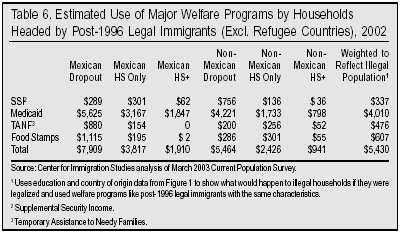
New numbers end any doubt about how much illegals take from welfare, for every $1 they spend they get $3 backk

Via Billy

https://cis.org/sites/cis.org/files/articles/2004/fiscal8.gif

Despite liberal insistence to the contrary, illegal immigration is a tremendous burden to the social safety net, especially in sanctuary cities.

Data from the LA County Department of Public Social Service shows that illegal immigrant families received upwards of $1.3 billion in LA County welfare payments during 2015 and 2016 alone.

This amounts to almost one-fourth of all dollars spent on helping the county’s poor, according to Fox News.

Los Angeles County, which allows welfare and food stamp benefits to go to illegal immigrants with children, also boasts the largest illegal immigrant population of any other U.S. county, according to the Migration Policy Institute.

And the financial effects are the “tip of the iceberg,” says Heritage Foundation senior fellow Robert Rector.