Showing posts sorted by relevance for query lee's surrender. Sort by date Show all posts

Wednesday, August 18, 2021

Battle of Appomattox: Understanding General Lee's Surrender

Brock: Hope all is well with you and yours.Appomattox Courthouse was the end of the Civil War, but the beginning of our national reconciliation. I wrote about it for our second piece on Civil War history: I've long loved the story of the surrender at Appomattox and what it says about the men who fought on both sides of the War Between the States. Give it a read and let me know what you think. As always, links are appreciated. ~~Sam-PS: We're launching a separate clothing company. We're not being public about the connection between the two companies for the moment, but any eyes you can get on these by linking is greatly appreciated: https://libertasbella.com/products/the-florida-man-t-shirt https://libertasbella.com/products/the-libertas-bella-news-t-shirt Ammo.com

********************** 

http://www.terryjamesart.com/images/items/enlarge/102.jpg

 Lee's Surrender, By My Great Grandfather, April 9,1865, 156 Years Ago

***************************

The Battle of Appomattox Courthouse is considered by many historians the end of the Civil War and the start of post-Civil War America. The events of General Robert E. Lee’s surrender to General and future President Ulysses S. Grant at a small town courthouse in Central Virginia put into effect much of what was to follow.

The surrender at Appomattox Courthouse was about reconciliation, healing, and restoring the Union. While the Radical Republicans had their mercifully brief time in the sun rubbing defeated Dixie’s nose in it, largely in response to the Southern "Black Codes," they represented the bleeding edge of Northern radicalism that wanted to punish the South, not reintegrate it into the Union as an equal partner.

More @ Ammo.Com

Saturday, April 9, 2011

Lee's Surrender, By My Great Grandfather, April 9, 1865, 146 Years Ago

http://www.terryjamesart.com/images/items/enlarge/102.jpg

Confederate Veteran May-June 1990

25th Anniversary of General Lee's Surrender April 9th, 1865

by John Pelopidas Leach, 1890

A quarter of a century has passed since General Lee surrendered the last hope of the Confederacy at Appomattox Court House.

For more than a year prior to that time, he had, with matchless skill, contended against vastly superior numbers and military resources, and successfully held at bay the grandest army ever marshaled on American soil. In the annals of American history, the name of this village will be preserved side-by-side with Yorktown, New Orleans and Mexico.

A private soldier, though a living witness, cannot describe a battle, much less a campaign. The field of observation to him is circumscribed and limited. But as I went with my companions to the last firing line, I have some vivid recollections of the event and I will relate my experiences and observations as a member of Company C, 53rd NC Regiment at Appomattox.

Before reaching Appomattox on the memorable retreat of our army from Petersburg, the half starved division of General Bryan Grimes, of which I belonged, was halted after dark for a short rest, and some of the *sharpshooters in the skirmish line, commanded by my brother, Lieutenant George T. Leach, also of Company C in the 53rd NC Regiment, collected and drove to our bivouac two or three cows with the intent of butchering them, believing, as they certainly had reason to believe, that the poor cattle would soon fall into the merciless hands of our pursuers.
View Image
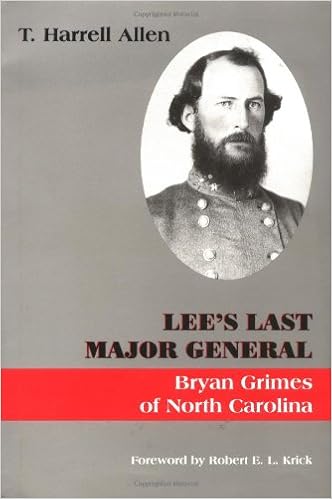
Major General Bryan Grimes


Reaching our stopping place, for we had no encampment there, Lieutenant Leach sent to headquarters to get permission to butcher the cows for his Corps of Sharpshooters, stating that his men were suffering from food. They had been constantly on the flanks and in the rear of the retreating army since the evacuation, marching, counter marching, retreating and fighting without food or rest. General Grimes peremptorily refused to allow the cattle to be killed, because to allow it would violate one of Lee's well-established rules prohibiting plundering at any cost.

He ordered the cows to be returned to the field from which they were driven, a mile or two back. The order was instantly executed as far as possible - the cattle were driven within range of the federal pickets and turned over to our pursuers. We marched on with empty stomachs and continued to hold the front line in an attempt to open the way for the retreat of the Army. However, unknown to General Grimes, General Gordon, the memorable right eye and at that time the right arm of Lee and in immediate command of all the forces there, had discovered that we were "flanked by 10,000 shotted guns and by 10,000 fronted."

l do not believe that General Lee could have put into battle that day more than eight or 10,000 men, hence it would have been cruel slaughter to have continued the war at that point one moment longer as we would have been forced to assume that of the aggressor against 50,000 well armed and well-fed veterans of Grant's Army who had lapped our feeble forces in front and upon both flanks. In order to continue the retreat and overcome the enemy would have been a military impossibility as well as a ridiculous and monstrous proposition in view of the worn-out condition of our soldiers who, though, were still willing to give battle with vigor and determination.

The actions of those engaged at Appomattox was but a skirmish preliminary to surrender and I have little doubt that General Grant and General Sheridan had planned to bring about the surrender of Lee or destroy his Army at that point. They accomplished their purpose with exceedingly small loss to those engaged under Lee.

Of those who participated in or were present at the McLean House at the time the terms of surrender were concluded, there are few who now live. General Lee had with him only one officer, Colonel Marshall, while General Grant was accompanied by a number of officers. The officers there present fairly represented in proportion the number of privates upon either side that could have been put into battle.

http://lh3.ggpht.com/_SUBGzd1BG60/SXKN0OX0JLI/AAAAAAABzaE/jaFSkpriN28/Lovell,+Surrender+at+Appomattox.jpg

We continued marching, counter-marching and skirmishing through the greater part of the night of April 8th and 9th. Then at sunrise we were deployed on a road and rail fence just beyond and in sight of the Court House. I do not recall the sight of a single dead Confederate that day though we drove some Union sharpshooters through the woods to the southwest where they made a stand on the edge of the woods and a few of them were killed and left upon the field.

Sheridan had placed some six-pound field guns in the woods in our front. They were keeping up a rapid fire when we advanced to their capture. Before we had gone half the distance, the guns were surrendered to a flanking party, and pretty soon were brought galloping across the field.

We escorted them to a point near the Court House and continued to advance to the west. We had gone less than a mile when the flag of truce was sent out and the firing ceased; this was no regular battle, though good men were killed and wounded in the skirmish. I think I saw the last gun fired that day. As we returned through the village, I saw some artillerymen prepare a gun for action. They opened fire upon a column of the enemy who were advancing from the south of the town, seeming unmindful of what had transpired at the front. An office rode up and ordered the gunners to cease firing. The various commands of the Army were much scattered and disorganized, but soon began to assemble in bivouac and before night were fed by our captors.

The Confederates were gathered over and around a large barren old field northeast of town when General Lee was seen to return from the village accompanied by Colonel Marshall. The whole Army rushed out to greet him and so thronged the road as to impede his passage. There was little cheering but no dearth of tears. Some wanted to hear a word from him, but if he spoke, I failed to catch his words. He waved his hand; the soldiers yielded the road and he passed on. He was very sad and perhaps could not restrain the tears. His bearing was erect and manly as a born ruler of men. He was a superb rider, always well mounted, but seldom rode out of a walk.

In a few moments, General John B.Gordon, who was at the time the idol of the Army, came along mounted upon a handsome bay mare, in a graceful canter. His dashing manner relieved the pent up-feelings of the men and they burst forth in wild applause. He passed through the assembled Army with hat in hand waving in response to their greeting. That evening and night speeches were made to the Army the best one by General Gordon.

View Image

Next morning we marched out under arms, fronted a column of Federals who stood in line at parade rest, stacked our guns and filed away to the South to fight never more for Dixie.

John Pelopidas Leach
Littleton, NC 1890

Edited by *Brock Townsend from many of the author's articles.
*The author's great grandson.

PS: An additional account states:

My Great, Grandfather Private John Pelopidus Leach wrote:

"Needham and Jack, faithful and devoted servants of my Brother Geo. T. Leach who then commanded my company, and Capt. Richardson who was captured at Fort Stedman, informed of the surrender, came to the front in search of my Brother and myself. They awoke me and gave me the first information I had of Lee's army, which I did not believe, until returning with them past the courthouse to the bivouac of the remnant of my company I saw the open field about the village full of straggling men, moving in aimless fashion, artillery, ambulances and wagons gathering in parks, many men crying, some cursing and all in pitiful distress."

"My command stacked arms in front of the victorious federals on the 10th of April, with one lieutenant, nine white men--all with guns-- and two Negro servants, Needham Leach of Chatham and Jack Richardson of Johnston County." (The Lieutenant was my great Uncle, George Thomas Leach)

"I with Needham, a Negro servant, as my only companion turned south to my home, Pittsboro, NC, passed through Chapel Hill and the Federal brigade of Gen. Atkins stationed there.

At Byrnums Mill on the Haw River, Needham and I were rowed across the stream in a bateau carrying the family servant of Maj. London, Sr. returning home with a bag of corn meal which he carried on the back of a mule."


================================================================

Shock Troops of the Confederacy

* Shock Troops of the Confederacy
"......the *sharpshooters of the Army of Northern Virginia played an important and sometimes pivotal role in many battles and campaigns in 1864 and 1865. Confederate General Robert Rodes organized the first battalion of sharpshooters in his brigade in early 1863, and later in each brigade of his division......in the trenches of Petersburg......"

================================================================

Before computers and when I lived in CA, I hired a NC lady to research the body servant of my g uncle, Needham Leach forward and she found the present day descendants of Needham! One of them lived close to me in CA and the others are still in Pittsboro. We've visited often and met my black Aunt Dixie who was named after my Great Aunt Dixie and a Cousin Dixie who is still alive and kicking in Pittsboro. I could not have been any happier. This was on my mothers side so I couldn't use my DNA and I could not get a male to do it on the Leach side. The reason I wanted this done was:

1. There was no slave listed in the 1860 census of Needham's age.

2. My gg grandfather would not have sent his eldest son off to war with a new, untested slave.

3. Needham is mentioned many times in letters home and he traveled back and forth between Virginia and NC obtaining provisions for my great uncle and grandfather.

4. He walked home from Appomattox with my great grandfather.

5. When he was married some years later, my gg grandfather traveled a long distance to be a witness at his wedding.
==================================================================
Lee's Surrender, By My Great Grandfather

Wednesday, April 9, 2014

Lee's Surrender, By My Great Grandfather, April 9, 1865, 149 Years Ago

http://www.terryjamesart.com/images/items/enlarge/102.jpg

 Yearly post


Confederate Veteran May-June 1990

25th Anniversary of General Lee's Surrender April 9th, 1865

by John Pelopidas Leach, 1890

A quarter of a century has passed since General Lee surrendered the last hope of the Confederacy at Appomattox Court House.

For more than a year prior to that time, he had, with matchless skill, contended against vastly superior numbers and military resources, and successfully held at bay the grandest army ever marshaled on American soil. In the annals of American history, the name of this village will be preserved side-by-side with Yorktown, New Orleans and Mexico.

A private soldier, though a living witness, cannot describe a battle, much less a campaign. The field of observation to him is circumscribed and limited. But as I went with my companions to the last firing line, I have some vivid recollections of the event and I will relate my experiences and observations as a member of Company C, 53rd NC Regiment at Appomattox.

Before reaching Appomattox on the memorable retreat of our army from Petersburg, the half starved division of General Bryan Grimes, of which I belonged, was halted after dark for a short rest, and some of the *sharpshooters in the skirmish line, commanded by my brother, Lieutenant George T. Leach, also of Company C in the 53rd NC Regiment, collected and drove to our bivouac two or three cows with the intent of butchering them, believing, as they certainly had reason to believe, that the poor cattle would soon fall into the merciless hands of our pursuers.

View Image
Major General Bryan Grimes

Reaching our stopping place, for we had no encampment there, Lieutenant Leach sent to headquarters to get permission to butcher the cows for his Corps of Sharpshooters, stating that his men were suffering from food. They had been constantly on the flanks and in the rear of the retreating army since the evacuation, marching, counter marching, retreating and fighting without food or rest. General Grimes peremptorily refused to allow the cattle to be killed, because to allow it would violate one of Lee's well-established rules prohibiting plundering at any cost.

He ordered the cows to be returned to the field from which they were driven, a mile or two back. The order was instantly executed as far as possible - the cattle were driven within range of the federal pickets and turned over to our pursuers. We marched on with empty stomachs and continued to hold the front line in an attempt to open the way for the retreat of the Army. However, unknown to General Grimes, General Gordon, the memorable right eye and at that time the right arm of Lee and in immediate command of all the forces there, had discovered that we were "flanked by 10,000 shotted guns and by 10,000 fronted."

l do not believe that General Lee could have put into battle that day more than eight or 10,000 men, hence it would have been cruel slaughter to have continued the war at that point one moment longer as we would have been forced to assume that of the aggressor against 50,000 well armed and well-fed veterans of Grant's Army who had lapped our feeble forces in front and upon both flanks. In order to continue the retreat and overcome the enemy would have been a military impossibility as well as a ridiculous and monstrous proposition in view of the worn-out condition of our soldiers who, though, were still willing to give battle with vigor and determination.

The actions of those engaged at Appomattox was but a skirmish preliminary to surrender and I have little doubt that General Grant and General Sheridan had planned to bring about the surrender of Lee or destroy his Army at that point. They accomplished their purpose with exceedingly small loss to those engaged under Lee.

Of those who participated in or were present at the McLean House at the time the terms of surrender were concluded, there are few who now live. General Lee had with him only one officer, Colonel Marshall, while General Grant was accompanied by a number of officers. The officers there present fairly represented in proportion the number of privates upon either side that could have been put into battle.

http://lh3.ggpht.com/_SUBGzd1BG60/SXKN0OX0JLI/AAAAAAABzaE/jaFSkpriN28/Lovell,+Surrender+at+Appomattox.jpg

We continued marching, counter-marching and skirmishing through the greater part of the night of April 8th and 9th. Then at sunrise we were deployed on a road and rail fence just beyond and in sight of the Court House. I do not recall the sight of a single dead Confederate that day though we drove some Union sharpshooters through the woods to the southwest where they made a stand on the edge of the woods and a few of them were killed and left upon the field.

Sheridan had placed some six-pound field guns in the woods in our front. They were keeping up a rapid fire when we advanced to their capture. Before we had gone half the distance, the guns were surrendered to a flanking party, and pretty soon were brought galloping across the field.

We escorted them to a point near the Court House and continued to advance to the west. We had gone less than a mile when the flag of truce was sent out and the firing ceased; this was no regular battle, though good men were killed and wounded in the skirmish. I think I saw the last gun fired that day. As we returned through the village, I saw some artillerymen prepare a gun for action. They opened fire upon a column of the enemy who were advancing from the south of the town, seeming unmindful of what had transpired at the front. An office rode up and ordered the gunners to cease firing. The various commands of the Army were much scattered and disorganized, but soon began to assemble in bivouac and before night were fed by our captors.

The Confederates were gathered over and around a large barren old field northeast of town when General Lee was seen to return from the village accompanied by Colonel Marshall. The whole Army rushed out to greet him and so thronged the road as to impede his passage. There was little cheering but no dearth of tears. Some wanted to hear a word from him, but if he spoke, I failed to catch his words. He waved his hand; the soldiers yielded the road and he passed on. He was very sad and perhaps could not restrain the tears. His bearing was erect and manly as a born ruler of men. He was a superb rider, always well mounted, but seldom rode out of a walk.

In a few moments, General John B.Gordon, who was at the time the idol of the Army, came along mounted upon a handsome bay mare, in a graceful canter. His dashing manner relieved the pent up-feelings of the men and they burst forth in wild applause. He passed through the assembled Army with hat in hand waving in response to their greeting. That evening and night speeches were made to the Army the best one by General Gordon.


View Image

Next morning we marched out under arms, fronted a column of Federals who stood in line at parade rest, stacked our guns and filed away to the South to fight never more for Dixie.

John Pelopidas Leach
Littleton, NC 1890

Edited by *Brock Townsend from many of the author's articles.
*The author's great grandson.

PS: An additional account states:

My Great, Grandfather Private John Pelopidus Leach wrote:

"Needham and Jack, faithful and devoted servants of my Brother Geo. T. Leach who then commanded my company, and Capt. Richardson who was captured at Fort Stedman, informed of the surrender, came to the front in search of my Brother and myself. They awoke me and gave me the first information I had of Lee's army, which I did not believe, until returning with them past the courthouse to the bivouac of the remnant of my company I saw the open field about the village full of straggling men, moving in aimless fashion, artillery, ambulances and wagons gathering in parks, many men crying, some cursing and all in pitiful distress."

"My command stacked arms in front of the victorious federals on the 10th of April, with one lieutenant, nine white men--all with guns-- and two Negro servants, Needham Leach of Chatham and Jack Richardson of Johnston County." (The Lieutenant was my great Uncle, George Thomas Leach)

"I with Needham, a Negro servant, as my only companion turned south to my home, Pittsboro, NC, passed through Chapel Hill and the Federal brigade of Gen. Atkins stationed there.

At Byrnums Mill on the Haw River, Needham and I were rowed across the stream in a bateau carrying the family servant of Maj. London, Sr. returning home with a bag of corn meal which he carried on the back of a mule."


================================================================

Shock Troops of the Confederacy

* Shock Troops of the Confederacy

"......the *sharpshooters of the Army of Northern Virginia played an important and sometimes pivotal role in many battles and campaigns in 1864 and 1865. Confederate General Robert Rodes organized the first battalion of sharpshooters in his brigade in early 1863, and later in each brigade of his division......in the trenches of Petersburg......"

================================================================

Before computers and when I lived in CA, I hired a NC lady to research the body servant of my g uncle, Needham Leach forward and she found the present day descendants of Needham! One of them lived close to me in CA and the others are still in Pittsboro. We've visited often and met my black Aunt Dixie who was named after my Great Aunt Dixie and a Cousin Dixie who is still alive and kicking in Pittsboro. I could not have been any happier. This was on my mothers side so I couldn't use my DNA and I could not get a male to do it on the Leach side. The reason I wanted this done was:

1. There was no slave listed in the 1860 census of Needham's age.

2. My gg grandfather would not have sent his eldest son off to war with a new, untested slave.

3. Needham is mentioned many times in letters home and he traveled back and forth between Virginia and NC obtaining provisions for my great uncle and grandfather.

4. He walked home from Appomattox with my great grandfather.

5. When he was married some years later, my gg grandfather traveled a long distance to be a witness at his wedding.

==================================================================

Lee's Surrender, By My Great Grandfather

Saturday, April 9, 2016

Lee's Surrender, By My Great Grandfather, April 9, 1865, 151 Years Ago

http://www.terryjamesart.com/images/items/enlarge/102.jpg

 Yearly post


Confederate Veteran May-June 1990

25th Anniversary of General Lee's Surrender April 9th, 1865

by John Pelopidas Leach, 1890

A quarter of a century has passed since General Lee surrendered the last hope of the Confederacy at Appomattox Court House.

For more than a year prior to that time, he had, with matchless skill, contended against vastly superior numbers and military resources, and successfully held at bay the grandest army ever marshaled on American soil. In the annals of American history, the name of this village will be preserved side-by-side with Yorktown, New Orleans and Mexico.

A private soldier, though a living witness, cannot describe a battle, much less a campaign. The field of observation to him is circumscribed and limited. But as I went with my companions to the last firing line, I have some vivid recollections of the event and I will relate my experiences and observations as a member of Company C, 53rd NC Regiment at Appomattox.

Before reaching Appomattox on the memorable retreat of our army from Petersburg, the half starved division of General Bryan Grimes, of which I belonged, was halted after dark for a short rest, and some of the *sharpshooters in the skirmish line, commanded by my brother, Lieutenant George T. Leach, also of Company C in the 53rd NC Regiment, collected and drove to our bivouac two or three cows with the intent of butchering them, believing, as they certainly had reason to believe, that the poor cattle would soon fall into the merciless hands of our pursuers.


View Image  
   Major General Bryan Grimes 
 
Reaching our stopping place, for we had no encampment there, Lieutenant Leach sent to headquarters to get permission to butcher the cows for his Corps of Sharpshooters, stating that his men were suffering from food. They had been constantly on the flanks and in the rear of the retreating army since the evacuation, marching, counter marching, retreating and fighting without food or rest. General Grimes peremptorily refused to allow the cattle to be killed, because to allow it would violate one of Lee's well-established rules prohibiting plundering at any cost.

He ordered the cows to be returned to the field from which they were driven, a mile or two back. The order was instantly executed as far as possible - the cattle were driven within range of the federal pickets and turned over to our pursuers. We marched on with empty stomachs and continued to hold the front line in an attempt to open the way for the retreat of the Army. However, unknown to General Grimes, General Gordon, the memorable right eye and at that time the right arm of Lee and in immediate command of all the forces there, had discovered that we were "flanked by 10,000 shotted guns and by 10,000 fronted."

l do not believe that General Lee could have put into battle that day more than eight or 10,000 men, hence it would have been cruel slaughter to have continued the war at that point one moment longer as we would have been forced to assume that of the aggressor against 50,000 well armed and well-fed veterans of Grant's Army who had lapped our feeble forces in front and upon both flanks. In order to continue the retreat and overcome the enemy would have been a military impossibility as well as a ridiculous and monstrous proposition in view of the worn-out condition of our soldiers who, though, were still willing to give battle with vigor and determination.

The actions of those engaged at Appomattox was but a skirmish preliminary to surrender and I have little doubt that General Grant and General Sheridan had planned to bring about the surrender of Lee or destroy his Army at that point. They accomplished their purpose with exceedingly small loss to those engaged under Lee.

Of those who participated in or were present at the McLean House at the time the terms of surrender were concluded, there are few who now live. General Lee had with him only one officer, Colonel Marshall, while General Grant was accompanied by a number of officers. The officers there present fairly represented in proportion the number of privates upon either side that could have been put into battle.


http://lh3.ggpht.com/_SUBGzd1BG60/SXKN0OX0JLI/AAAAAAABzaE/jaFSkpriN28/Lovell,+Surrender+at+Appomattox.jpg

We continued marching, counter-marching and skirmishing through the greater part of the night of April 8th and 9th. Then at sunrise we were deployed on a road and rail fence just beyond and in sight of the Court House. I do not recall the sight of a single dead Confederate that day though we drove some Union sharpshooters through the woods to the southwest where they made a stand on the edge of the woods and a few of them were killed and left upon the field.

Sheridan had placed some six-pound field guns in the woods in our front. They were keeping up a rapid fire when we advanced to their capture. Before we had gone half the distance, the guns were surrendered to a flanking party, and pretty soon were brought galloping across the field.

We escorted them to a point near the Court House and continued to advance to the west. We had gone less than a mile when the flag of truce was sent out and the firing ceased; this was no regular battle, though good men were killed and wounded in the skirmish. I think I saw the last gun fired that day. As we returned through the village, I saw some artillerymen prepare a gun for action. They opened fire upon a column of the enemy who were advancing from the south of the town, seeming unmindful of what had transpired at the front. An office rode up and ordered the gunners to cease firing. The various commands of the Army were much scattered and disorganized, but soon began to assemble in bivouac and before night were fed by our captors.

The Confederates were gathered over and around a large barren old field northeast of town when General Lee was seen to return from the village accompanied by Colonel Marshall. The whole Army rushed out to greet him and so thronged the road as to impede his passage. There was little cheering but no dearth of tears. Some wanted to hear a word from him, but if he spoke, I failed to catch his words. He waved his hand; the soldiers yielded the road and he passed on. He was very sad and perhaps could not restrain the tears. His bearing was erect and manly as a born ruler of men. He was a superb rider, always well mounted, but seldom rode out of a walk.

In a few moments, General John B.Gordon, who was at the time the idol of the Army, came along mounted upon a handsome bay mare, in a graceful canter. His dashing manner relieved the pent up-feelings of the men and they burst forth in wild applause. He passed through the assembled Army with hat in hand waving in response to their greeting. That evening and night speeches were made to the Army the best one by General Gordon.


View Image

Next morning we marched out under arms, fronted a column of Federals who stood in line at parade rest, stacked our guns and filed away to the South to fight never more for Dixie.

John Pelopidas Leach
Littleton, NC 1890

Edited by *Brock Townsend from many of the author's articles.
*The author's great grandson.

PS: An additional account states:

My Great, Grandfather Private John Pelopidus Leach wrote:

"Needham and Jack, faithful and devoted servants of my Brother Geo. T. Leach who then commanded my company, and Capt. Richardson who was captured at Fort Stedman, informed of the surrender, came to the front in search of my Brother and myself. They awoke me and gave me the first information I had of Lee's army, which I did not believe, until returning with them past the courthouse to the bivouac of the remnant of my company I saw the open field about the village full of straggling men, moving in aimless fashion, artillery, ambulances and wagons gathering in parks, many men crying, some cursing and all in pitiful distress."

"My command stacked arms in front of the victorious federals on the 10th of April, with one lieutenant, nine white men--all with guns-- and two Negro servants, Needham Leach of Chatham and Jack Richardson of Johnston County." (The Lieutenant was my great Uncle, George Thomas Leach)

"I with Needham, a Negro servant, as my only companion turned south to my home, Pittsboro, NC, passed through Chapel Hill and the Federal brigade of Gen. Atkins stationed there.

At Byrnums Mill on the Haw River, Needham and I were rowed across the stream in a bateau carrying the family servant of Maj. London, Sr. returning home with a bag of corn meal which he carried on the back of a mule."


================================================================


Shock Troops of the Confederacy

* Shock Troops of the Confederacy

"......the *sharpshooters of the Army of Northern Virginia played an important and sometimes pivotal role in many battles and campaigns in 1864 and 1865. Confederate General Robert Rodes organized the first battalion of sharpshooters in his brigade in early 1863, and later in each brigade of his division......in the trenches of Petersburg......"

================================================================

Before computers and when I lived in CA, I hired a NC lady to research the body servant of my g uncle, Needham Leach forward and she found the present day descendants of Needham! One of them lived close to me in CA and the others are still in Pittsboro. We've visited often and met my black Aunt Dixie who was named after my Great Aunt Dixie and a Cousin Dixie who is still alive and kicking in Pittsboro. I could not have been any happier. This was on my mothers side so I couldn't use my DNA and I could not get a male to do it on the Leach side. The reason I wanted this done was:

1. There was no slave listed in the 1860 census of Needham's age.

2. My gg grandfather would not have sent his eldest son off to war with a new, untested slave.

3. Needham is mentioned many times in letters home and he traveled back and forth between Virginia and NC obtaining provisions for my great uncle and grandfather.

4. He walked home from Appomattox with my great grandfather.

5. When he was married some years later, my gg grandfather traveled a long distance to be a witness at his wedding.

==================================================================

Lee's Surrender, By My Great Grandfather

Monday, April 9, 2012

Lee's Surrender, By My Great Grandfather, April 9, 1865, 147 Years Ago

Yearly post.

http://www.terryjamesart.com/images/items/enlarge/102.jpg

Confederate Veteran May-June 1990

25th Anniversary of General Lee's Surrender April 9th, 1865

by John Pelopidas Leach, 1890

A quarter of a century has passed since General Lee surrendered the last hope of the Confederacy at Appomattox Court House.

For more than a year prior to that time, he had, with matchless skill, contended against vastly superior numbers and military resources, and successfully held at bay the grandest army ever marshaled on American soil. In the annals of American history, the name of this village will be preserved side-by-side with Yorktown, New Orleans and Mexico.

A private soldier, though a living witness, cannot describe a battle, much less a campaign. The field of observation to him is circumscribed and limited. But as I went with my companions to the last firing line, I have some vivid recollections of the event and I will relate my experiences and observations as a member of Company C, 53rd NC Regiment at Appomattox.

Before reaching Appomattox on the memorable retreat of our army from Petersburg, the half starved division of General Bryan Grimes, of which I belonged, was halted after dark for a short rest, and some of the *sharpshooters in the skirmish line, commanded by my brother, Lieutenant George T. Leach, also of Company C in the 53rd NC Regiment, collected and drove to our bivouac two or three cows with the intent of butchering them, believing, as they certainly had reason to believe, that the poor cattle would soon fall into the merciless hands of our pursuers.
View Image
Major General Bryan Grimes

Reaching our stopping place, for we had no encampment there, Lieutenant Leach sent to headquarters to get permission to butcher the cows for his Corps of Sharpshooters, stating that his men were suffering from food. They had been constantly on the flanks and in the rear of the retreating army since the evacuation, marching, counter marching, retreating and fighting without food or rest. General Grimes peremptorily refused to allow the cattle to be killed, because to allow it would violate one of Lee's well-established rules prohibiting plundering at any cost.

He ordered the cows to be returned to the field from which they were driven, a mile or two back. The order was instantly executed as far as possible - the cattle were driven within range of the federal pickets and turned over to our pursuers. We marched on with empty stomachs and continued to hold the front line in an attempt to open the way for the retreat of the Army. However, unknown to General Grimes, General Gordon, the memorable right eye and at that time the right arm of Lee and in immediate command of all the forces there, had discovered that we were "flanked by 10,000 shotted guns and by 10,000 fronted."

l do not believe that General Lee could have put into battle that day more than eight or 10,000 men, hence it would have been cruel slaughter to have continued the war at that point one moment longer as we would have been forced to assume that of the aggressor against 50,000 well armed and well-fed veterans of Grant's Army who had lapped our feeble forces in front and upon both flanks. In order to continue the retreat and overcome the enemy would have been a military impossibility as well as a ridiculous and monstrous proposition in view of the worn-out condition of our soldiers who, though, were still willing to give battle with vigor and determination.

The actions of those engaged at Appomattox was but a skirmish preliminary to surrender and I have little doubt that General Grant and General Sheridan had planned to bring about the surrender of Lee or destroy his Army at that point. They accomplished their purpose with exceedingly small loss to those engaged under Lee.

Of those who participated in or were present at the McLean House at the time the terms of surrender were concluded, there are few who now live. General Lee had with him only one officer, Colonel Marshall, while General Grant was accompanied by a number of officers. The officers there present fairly represented in proportion the number of privates upon either side that could have been put into battle.

http://lh3.ggpht.com/_SUBGzd1BG60/SXKN0OX0JLI/AAAAAAABzaE/jaFSkpriN28/Lovell,+Surrender+at+Appomattox.jpg

We continued marching, counter-marching and skirmishing through the greater part of the night of April 8th and 9th. Then at sunrise we were deployed on a road and rail fence just beyond and in sight of the Court House. I do not recall the sight of a single dead Confederate that day though we drove some Union sharpshooters through the woods to the southwest where they made a stand on the edge of the woods and a few of them were killed and left upon the field.

Sheridan had placed some six-pound field guns in the woods in our front. They were keeping up a rapid fire when we advanced to their capture. Before we had gone half the distance, the guns were surrendered to a flanking party, and pretty soon were brought galloping across the field.

We escorted them to a point near the Court House and continued to advance to the west. We had gone less than a mile when the flag of truce was sent out and the firing ceased; this was no regular battle, though good men were killed and wounded in the skirmish. I think I saw the last gun fired that day. As we returned through the village, I saw some artillerymen prepare a gun for action. They opened fire upon a column of the enemy who were advancing from the south of the town, seeming unmindful of what had transpired at the front. An office rode up and ordered the gunners to cease firing. The various commands of the Army were much scattered and disorganized, but soon began to assemble in bivouac and before night were fed by our captors.

The Confederates were gathered over and around a large barren old field northeast of town when General Lee was seen to return from the village accompanied by Colonel Marshall. The whole Army rushed out to greet him and so thronged the road as to impede his passage. There was little cheering but no dearth of tears. Some wanted to hear a word from him, but if he spoke, I failed to catch his words. He waved his hand; the soldiers yielded the road and he passed on. He was very sad and perhaps could not restrain the tears. His bearing was erect and manly as a born ruler of men. He was a superb rider, always well mounted, but seldom rode out of a walk.

In a few moments, General John B.Gordon, who was at the time the idol of the Army, came along mounted upon a handsome bay mare, in a graceful canter. His dashing manner relieved the pent up-feelings of the men and they burst forth in wild applause. He passed through the assembled Army with hat in hand waving in response to their greeting. That evening and night speeches were made to the Army the best one by General Gordon.

View Image

Next morning we marched out under arms, fronted a column of Federals who stood in line at parade rest, stacked our guns and filed away to the South to fight never more for Dixie.

John Pelopidas Leach
Littleton, NC 1890

Edited by *Brock Townsend from many of the author's articles.
*The author's great grandson.

PS: An additional account states:

My Great, Grandfather Private John Pelopidus Leach wrote:

"Needham and Jack, faithful and devoted servants of my Brother Geo. T. Leach who then commanded my company, and Capt. Richardson who was captured at Fort Stedman, informed of the surrender, came to the front in search of my Brother and myself. They awoke me and gave me the first information I had of Lee's army, which I did not believe, until returning with them past the courthouse to the bivouac of the remnant of my company I saw the open field about the village full of straggling men, moving in aimless fashion, artillery, ambulances and wagons gathering in parks, many men crying, some cursing and all in pitiful distress."

"My command stacked arms in front of the victorious federals on the 10th of April, with one lieutenant, nine white men--all with guns-- and two Negro servants, Needham Leach of Chatham and Jack Richardson of Johnston County." (The Lieutenant was my great Uncle, George Thomas Leach)

"I with Needham, a Negro servant, as my only companion turned south to my home, Pittsboro, NC, passed through Chapel Hill and the Federal brigade of Gen. Atkins stationed there.

At Byrnums Mill on the Haw River, Needham and I were rowed across the stream in a bateau carrying the family servant of Maj. London, Sr. returning home with a bag of corn meal which he carried on the back of a mule."


================================================================

Shock Troops of the Confederacy

* Shock Troops of the Confederacy
"......the *sharpshooters of the Army of Northern Virginia played an important and sometimes pivotal role in many battles and campaigns in 1864 and 1865. Confederate General Robert Rodes organized the first battalion of sharpshooters in his brigade in early 1863, and later in each brigade of his division......in the trenches of Petersburg......"

================================================================

Before computers and when I lived in CA, I hired a NC lady to research the body servant of my g uncle, Needham Leach forward and she found the present day descendants of Needham! One of them lived close to me in CA and the others are still in Pittsboro. We've visited often and met my black Aunt Dixie who was named after my Great Aunt Dixie and a Cousin Dixie who is still alive and kicking in Pittsboro. I could not have been any happier. This was on my mothers side so I couldn't use my DNA and I could not get a male to do it on the Leach side. The reason I wanted this done was:

1. There was no slave listed in the 1860 census of Needham's age.

2. My gg grandfather would not have sent his eldest son off to war with a new, untested slave.

3. Needham is mentioned many times in letters home and he traveled back and forth between Virginia and NC obtaining provisions for my great uncle and grandfather.

4. He walked home from Appomattox with my great grandfather.

5. When he was married some years later, my gg grandfather traveled a long distance to be a witness at his wedding.
==================================================================

Sunday, April 9, 2017

Lee's Surrender, By My Great Grandfather, April 9, 1865, 152 Years Ago

http://www.terryjamesart.com/images/items/enlarge/102.jpg
Yearly post

Confederate Veteran May-June 1990

25th Anniversary of General Lee's Surrender April 9th, 1865

by John Pelopidas Leach, 1890

A quarter of a century has passed since General Lee surrendered the last hope of the Confederacy at Appomattox Court House.

For more than a year prior to that time, he had, with matchless skill, contended against vastly superior numbers and military resources, and successfully held at bay the grandest army ever marshaled on American soil. In the annals of American history, the name of this village will be preserved side-by-side with Yorktown, New Orleans and Mexico.

A private soldier, though a living witness, cannot describe a battle, much less a campaign. The field of observation to him is circumscribed and limited. But as I went with my companions to the last firing line, I have some vivid recollections of the event and I will relate my experiences and observations as a member of Company C, 53rd NC Regiment at Appomattox.

Before reaching Appomattox on the memorable retreat of our army from Petersburg, the half starved division of General Bryan Grimes, of which I belonged, was halted after dark for a short rest, and some of the *sharpshooters in the skirmish line, commanded by my brother, Lieutenant George T. Leach, also of Company C in the 53rd NC Regiment, collected and drove to our bivouac two or three cows with the intent of butchering them, believing, as they certainly had reason to believe, that the poor cattle would soon fall into the merciless hands of our pursuers.


https://images-na.ssl-images-amazon.com/images/I/41Qkkc1pwsL._SX330_BO1,204,203,200_.jpg
 
Reaching our stopping place, for we had no encampment there, Lieutenant Leach sent to headquarters to get permission to butcher the cows for his Corps of Sharpshooters, stating that his men were suffering from food. They had been constantly on the flanks and in the rear of the retreating army since the evacuation, marching, counter marching, retreating and fighting without food or rest. General Grimes peremptorily refused to allow the cattle to be killed, because to allow it would violate one of Lee's well-established rules prohibiting plundering at any cost.

He ordered the cows to be returned to the field from which they were driven, a mile or two back. The order was instantly executed as far as possible - the cattle were driven within range of the federal pickets and turned over to our pursuers. We marched on with empty stomachs and continued to hold the front line in an attempt to open the way for the retreat of the Army. However, unknown to General Grimes, General Gordon, the memorable right eye and at that time the right arm of Lee and in immediate command of all the forces there, had discovered that we were "flanked by 10,000 shotted guns and by 10,000 fronted."

l do not believe that General Lee could have put into battle that day more than eight or 10,000 men, hence it would have been cruel slaughter to have continued the war at that point one moment longer as we would have been forced to assume that of the aggressor against 50,000 well armed and well-fed veterans of Grant's Army who had lapped our feeble forces in front and upon both flanks. In order to continue the retreat and overcome the enemy would have been a military impossibility as well as a ridiculous and monstrous proposition in view of the worn-out condition of our soldiers who, though, were still willing to give battle with vigor and determination.

The actions of those engaged at Appomattox was but a skirmish preliminary to surrender and I have little doubt that General Grant and General Sheridan had planned to bring about the surrender of Lee or destroy his Army at that point. They accomplished their purpose with exceedingly small loss to those engaged under Lee.

Of those who participated in or were present at the McLean House at the time the terms of surrender were concluded, there are few who now live. General Lee had with him only one officer, Colonel Marshall, while General Grant was accompanied by a number of officers. The officers there present fairly represented in proportion the number of privates upon either side that could have been put into battle.

http://thisweekinthecivilwar.com/wp-content/uploads/2015/04/appomattox-1.jpg
 
We continued marching, counter-marching and skirmishing through the greater part of the night of April 8th and 9th. Then at sunrise we were deployed on a road and rail fence just beyond and in sight of the Court House. I do not recall the sight of a single dead Confederate that day though we drove some Union sharpshooters through the woods to the southwest where they made a stand on the edge of the woods and a few of them were killed and left upon the field.

Sheridan had placed some six-pound field guns in the woods in our front. They were keeping up a rapid fire when we advanced to their capture. Before we had gone half the distance, the guns were surrendered to a flanking party, and pretty soon were brought galloping across the field.

We escorted them to a point near the Court House and continued to advance to the west. We had gone less than a mile when the flag of truce was sent out and the firing ceased; this was no regular battle, though good men were killed and wounded in the skirmish. I think I saw the last gun fired that day. As we returned through the village, I saw some artillerymen prepare a gun for action. They opened fire upon a column of the enemy who were advancing from the south of the town, seeming unmindful of what had transpired at the front. An office rode up and ordered the gunners to cease firing. The various commands of the Army were much scattered and disorganized, but soon began to assemble in bivouac and before night were fed by our captors.

The Confederates were gathered over and around a large barren old field northeast of town when General Lee was seen to return from the village accompanied by Colonel Marshall. The whole Army rushed out to greet him and so thronged the road as to impede his passage. There was little cheering but no dearth of tears. Some wanted to hear a word from him, but if he spoke, I failed to catch his words. He waved his hand; the soldiers yielded the road and he passed on. He was very sad and perhaps could not restrain the tears. His bearing was erect and manly as a born ruler of men. He was a superb rider, always well mounted, but seldom rode out of a walk.

In a few moments, General John B.Gordon, who was at the time the idol of the Army, came along mounted upon a handsome bay mare, in a graceful canter. His dashing manner relieved the pent up-feelings of the men and they burst forth in wild applause. He passed through the assembled Army with hat in hand waving in response to their greeting. That evening and night speeches were made to the Army the best one by General Gordon.

View Image

Next morning we marched out under arms, fronted a column of Federals who stood in line at parade rest, stacked our guns and filed away to the South to fight never more for Dixie.

John Pelopidas Leach
Littleton, NC 1890

Edited by *Brock Townsend from many of the author's articles.
*The author's great grandson.

PS: An additional account states:

My Great, Grandfather Private John Pelopidus Leach wrote:

"Needham and Jack, faithful and devoted servants of my Brother Geo. T. Leach who then commanded my company, and Capt. Richardson who was captured at Fort Stedman, informed of the surrender, came to the front in search of my Brother and myself. They awoke me and gave me the first information I had of Lee's army, which I did not believe, until returning with them past the courthouse to the bivouac of the remnant of my company I saw the open field about the village full of straggling men, moving in aimless fashion, artillery, ambulances and wagons gathering in parks, many men crying, some cursing and all in pitiful distress."

"My command stacked arms in front of the victorious federals on the 10th of April, with one lieutenant, nine white men--all with guns-- and two Negro servants, Needham Leach of Chatham and Jack Richardson of Johnston County." (The Lieutenant was my great Uncle, George Thomas Leach)

"I with Needham, a Negro servant, as my only companion turned south to my home, Pittsboro, NC, passed through Chapel Hill and the Federal brigade of Gen. Atkins stationed there.

At Byrnums Mill on the Haw River, Needham and I were rowed across the stream in a bateau carrying the family servant of Maj. London, Sr. returning home with a bag of corn meal which he carried on the back of a mule."


================================================================

Shock Troops of the Confederacy

* Shock Troops of the Confederacy

"......the *sharpshooters of the Army of Northern Virginia played an important and sometimes pivotal role in many battles and campaigns in 1864 and 1865. Confederate General Robert Rodes organized the first battalion of sharpshooters in his brigade in early 1863, and later in each brigade of his division......in the trenches of Petersburg......"

================================================================

Before computers and when I lived in CA, I hired a NC lady to research the body servant of my g uncle, Needham Leach forward and she found the present day descendants of Needham! One of them lived close to me in CA and the others are still in Pittsboro. We've visited often and met my black Aunt Dixie who was named after my Great Aunt Dixie and a Cousin Dixie who is still alive and kicking in Pittsboro. I could not have been any happier. This was on my mothers side so I couldn't use my DNA and I could not get a male to do it on the Leach side. The reason I wanted this done was:

1. There was no slave listed in the 1860 census of Needham's age.

2. My gg grandfather would not have sent his eldest son off to war with a new, untested slave.

3. Needham is mentioned many times in letters home and he traveled back and forth between Virginia and NC obtaining provisions for my great uncle and grandfather.

4. He walked home from Appomattox with my great grandfather.

5. When he was married some years later, my gg grandfather traveled a long distance to be a witness at his wedding.

==================================================================

Lee's Surrender, By My Great Grandfather

Saturday, April 9, 2016

The War Didn’t End At Appomattox

Via Billy

Image result for stand watie

We have arrived at that time of year where the “historians” never hesitate to tell us about Robert E. Lee’s surrender at Appomattox, and the distinct impression given in most articles and history books is the Lee’s surrender was automatically the end of the War. If not stated directly, it is implied that when Lee surrendered the South surrendered. Not quite so. All that Lee surrendered was the Army of Northern Virginia, nothing else. As commander of all the Confederate armies at that time, he could have surrendered them all. He didn’t.

Joe Johnston surrendered his army in North Carolina at the end of April and other Confederate generals surrendered as May and June dragged on. Some, like Jo Shelby, refused to surrender.  They buried their battle flags in the Rio Grande and crossed over into Mexico. Others just walked away. *I have been told though I can’t verify it, that Cherokee General Stand Watie did not technically surrender. Rather he signed a “cessation of hostilities” agreement and his men went home with their weapons. A more informed historian than me might know more about that.


*On June 23, 1865, at Doaksville in the Choctaw Nation, Watie signed a cease-fire agreement with Union representatives for his command, the First Indian Brigade of the Army of the Trans-Mississippi. He was the last Confederate general in the field to stop fighting.[11][18][19]

**************************************


A good friend of mine who is now gone, most unfortunately, especially for the history of the Cherokee, as he wrote what I consider THE book on Stand Watie. (He was working on another book when he died and his worthless daughter and son were not interested and would not even let me have his writings, so that I could do something with them. I have no use for people that don't love their families.) His wife's grandfather rode with Watie. The book is called Red Fox, Stand Watie's Years in Indian Territory, by Wilfred Knight. He begins the book with this poem that he wrote:

No monuments or marble shafts
Keep silent record of the time
When grey clan ranks of warriors rode
The Indian Nation line.

But mists of time have not eclipsed
The ancient stories of the day,
And still the whispered words are heard,
"Stand Watie passed this way."

The noon of darkness casts its spell:
Dutch Billy's bugle sounds once more
And Watie heads his column out
To ride through legend's door.

Now once again the muskets fire
While "Eagle" Buzzard spirits soars,
And smoothbores spew their deadly hail
As Watie leads to war.

But now - the Red Fox rides no more,
No bands of men, with muffled sound
Slip through the night to strike at dawn;
The fight is thru, the moon is down.

Now who will sing old Watie's song,
And who will tell his tale,
And who will keep the rendezvous
Along the Texas Trail?


(Hollywood Cemetery, Los Angeles, CA Confederate Memorial Day 1992? I'm wearing my father's blue seersucker suit on the left standing beside my friend in the blue blazer, Wilfred Knight, a true Confederate and a gentleman. BT)

Tuesday, May 1, 2018

The Last Salute of the Army of Northern Virginia

 Image result for end of civil war

The following is an article which provides General Joshua Chamberlain's comments and memories concerning the Army of Northern Virginia's Surrender at Appomattox.

The Last Salute Of The Army Of Northern Virginia. 
 
From the Boston Journal, May, 1901
 
Details of the Surrender of General Lee at Appomattox Courthouse, April 9th, 1865.

LENIENT TERMS OF GENERAL GRANT.

By General J. L. Chamberlain.
It is an astounding fact that among the thousands of official documents bearing upon the Civil war in the National Archives at Washington there is absolutely nothing dealing with one of the most dramatic features of the great four years' internal struggle--the actual ceremonies attendant upon the formal surrender by General Lee's army of all Confederate property in their possession at Appomattox Courthouse thirty-six years ago.

When General Lee surrendered to General Grant, April 9th, 1865, the war was virtually over, but of the details of the surrender, the pathetic sadness on the one side, the jubilant satisfaction on the other, and, more particularly of the precise arrangements, the mode of procedure and the Northern army officer whose duty it became to take charge of the rebel arms and the rebel battleflags as they were given up--of all this our official war records tell not a word.

Friday, April 9, 2021

Lee's Surrender, By My Great Grandfather, April 9, 1865, 156 Years Ago


http://www.terryjamesart.com/images/items/enlarge/102.jpg

 May be an image of monument, outdoors and text that says 'LEACH ERECTED BY HIS COLORED FRIENDS' 

In 1914, John Pelopidus Leach died, and the monument below was erected to him in Littleton. It depicts two hands shaking, one black and one white, with the inscription, "This Is What He Meant, All Men Up Erected By His Colored Friends." Private/Captain/Colonel/Judge Leach donated the land for the Enon Baptist Church in Littleton, and was generous to the poor and needy throughout his life.

Confederate Veteran May-June 1990

25th Anniversary of General Lee's Surrender April 9th, 1865

by John Pelopidas Leach, 1890

A quarter of a century has passed since General Lee surrendered the last hope of the Confederacy at Appomattox Court House.

For more than a year prior to that time, he had, with matchless skill, contended against vastly superior numbers and military resources, and successfully held at bay the grandest army ever marshaled on American soil. In the annals of American history, the name of this village will be preserved side-by-side with Yorktown, New Orleans and Mexico.

A private soldier, though a living witness, cannot describe a battle, much less a campaign. The field of observation to him is circumscribed and limited. But as I went with my companions to the last firing line, I have some vivid recollections of the event and I will relate my experiences and observations as a member of Company C, 53rd NC Regiment at Appomattox.

Before reaching Appomattox on the memorable retreat of our army from Petersburg, the half starved division of General Bryan Grimes, of which I belonged, was halted after dark for a short rest, and some of the *sharpshooters  in the skirmish line, commanded by my brother, Lieutenant George T. Leach, also of Company C in the 53rd NC Regiment, collected and drove to our bivouac two or three cows with the intent of butchering them, believing, as they certainly had reason to believe, that the poor cattle would soon fall into the merciless hands of our pursuers.

Reaching our stopping place, for we had no encampment there, Lieutenant Leach sent to headquarters to get permission to butcher the cows for his Corps of Sharpshooters, stating that his men were suffering from food. They had been constantly on the flanks and in the rear of the retreating army since the evacuation, marching, counter marching, retreating and fighting without food or rest. General Grimes peremptorily refused to allow the cattle to be killed, because to allow it would violate one of Lee's well-established rules prohibiting plundering at any cost.

He ordered the cows to be returned to the field from which they were driven, a mile or two back. The order was instantly executed as far as possible - the cattle were driven within range of the federal pickets and turned over to our pursuers. We marched on with empty stomachs and continued to hold the front line in an attempt to open the way for the retreat of the Army. However, unknown to General Grimes, General Gordon, the memorable right eye and at that time the right arm of Lee and in immediate command of all the forces there, had discovered that we were "flanked by 10,000 shotted guns and by 10,000 fronted."

l do not believe that General Lee could have put into battle that day more than eight or 10,000 men, hence it would have been cruel slaughter to have continued the war at that point one moment longer as we would have been forced to assume that of the aggressor against 50,000 well armed and well-fed veterans of Grant's Army who had lapped our feeble forces in front and upon both flanks. In order to continue the retreat and overcome the enemy would have been a military impossibility as well as a ridiculous and monstrous proposition in view of the worn-out condition of our soldiers who, though, were still willing to give battle with vigor and determination.

The actions of those engaged at Appomattox was but a skirmish preliminary to surrender and I have little doubt that General Grant and General Sheridan had planned to bring about the surrender of Lee or destroy his Army at that point. They accomplished their purpose with exceedingly small loss to those engaged under Lee.

Of those who participated in or were present at the McLean House at the time the terms of surrender were concluded, there are few who now live. General Lee had with him only one officer, Colonel Marshall, while General Grant was accompanied by a number of officers. The officers there present fairly represented in proportion the number of privates upon either side that could have been put into battle.

We continued marching, counter-marching and skirmishing through the greater part of the night of April 8th and 9th. Then at sunrise we were deployed on a road and rail fence just beyond and in sight of the Court House. I do not recall the sight of a single dead Confederate that day though we drove some Union sharpshooters through the woods to the southwest where they made a stand on the edge of the woods and a few of them were killed and left upon the field.

Sheridan had placed some six-pound field guns in the woods in our front. They were keeping up a rapid fire when we advanced to their capture. Before we had gone half the distance, the guns were surrendered to a flanking party, and pretty soon were brought galloping across the field.

We escorted them to a point near the Court House and continued to advance to the west. We had gone less than a mile when the flag of truce was sent out and the firing ceased; this was no regular battle, though good men were killed and wounded in the skirmish. I think I saw the last gun fired that day. As we returned through the village, I saw some artillerymen prepare a gun for action. They opened fire upon a column of the enemy who were advancing from the south of the town, seeming unmindful of what had transpired at the front. An office rode up and ordered the gunners to cease firing. The various commands of the Army were much scattered and disorganized, but soon began to assemble in bivouac and before night were fed by our captors.

The Confederates were gathered over and around a large barren old field northeast of town when General Lee was seen to return from the village accompanied by Colonel Marshall. The whole Army rushed out to greet him and so thronged the road as to impede his passage. There was little cheering but no dearth of tears. Some wanted to hear a word from him, but if he spoke, I failed to catch his words. He waved his hand; the soldiers yielded the road and he passed on. He was very sad and perhaps could not restrain the tears. His bearing was erect and manly as a born ruler of men. He was a superb rider, always well mounted, but seldom rode out of a walk.

In a few moments, General John B.Gordon, who was at the time the idol of the Army, came along mounted upon a handsome bay mare, in a graceful canter. His dashing manner relieved the pent up-feelings of the men and they burst forth in wild applause. He passed through the assembled Army with hat in hand waving in response to their greeting. That evening and night speeches were made to the Army the best one by General Gordon.

Next morning we marched out under arms, fronted a column of Federals who stood in line at parade rest, stacked our guns and filed away to the South to fight never more for Dixie.

John Pelopidas Leach
Littleton, NC 1890

Edited by *Brock Townsend from many of the author's articles.
*The author's great grandson.

More @ FNC

Friday, January 11, 2013

Period Fair Copy of General Order, No. 9 Signed "R E Lee Genl."

A Treasure

Autographs:Military Figures, Robert E. Lee Period Fair Copy of General Or... Image #1 

Robert E. Lee Period Fair Copy of General Order, No. 9 Signed "R E Lee Genl." One page, 10" x 8.25", "Head. Quarters. A. N. Va. [Appomattox Court House, Virginia]," April 10, 1865. Following Grant's breakthrough of the Confederate lines after the Battle of Five Forks on April 1, 1865, Lee evacuated Petersburg and the Confederate capital of Richmond, leading his army west toward Appomattox where a supply train awaited him. His plan was to turn south and join forces with Joseph E. Johnston and the Army of Tennessee in North Carolina. Unfortunately, George Armstrong Custer's cavalry destroyed the three supply trains awaiting Lee at Appomattox on April 8. Lee arrived that night and immediately resolved to push on to Lynchburg the following morning, where another supply train could replenish his army. By the morning of the 9th, however, he found himself surrounded by Federal troops. He made one last desperate attempt, sending John B. Gordon to break through the Union cavalry guarding the western exit. When the attempt failed, Lee had no choice but to surrender. He negotiated a ceasefire and, meeting Lt. Gen. Ulysses S. Grant at the house of Wilmer McLean, surrendered himself and the Army of Northern Virginia.

The following day, Lee's aide-de-camp, Col. Charles Marshall, at the insistence of the general, drafted General Order, No. 9, also known as Lee's Farewell Address. This copy has some very minor grammatical changes from most transcriptions and reads, in full: "After four years of arduous service, marked by unsurpassed courage and fortitude, the Army of Northern Virginia has been compelled to yield to overwhelming numbers and resources. I need not tell the survivors of so many hard-fought battles, who have remained steadfast to the last, that I have consented to this result from no distrust of them. But feeling that valor and devotion could accomplish nothing that could compensate for the loss that must have attended the continuance of the contest, I have determined to avoid the useless sacrifice of those whose past services have endeared them to their countrymen. By the terms of agreement officers and men can return to their homes and remain until exchanged. You will take with you the satisfaction that proceeds from the consciousness of duty faithfully performed, and I earnestly pray that a merciful God will extend to you his blessing and protection. With an unceasing admiration of your constancy and devotion to your country and a grateful remembrance of your kind and generous consideration for myself, I bid you all an affectionate farewell."

Though we will never be sure who is responsible for the creation of this particular copy, the lower quality paper used in its production is consistent with that used by Confederate soldiers at the time. Interesting to note is the ink used to transcribe this order is the same ink that Lee used when he signed his name and leads one to believe that Lee was present at its creation. Also evident are three small thumbprints found near the lower left edge. It is not certain to whom they belong, but it is a distinct possibility that these prints belong to the great general. Light waterstaining along the lower right edge and lower left corner, causing slight smudging of "Genl" following Lee's signature. Two small ink spots at left edge. Folds are weakened with slight separation at places along the vertical fold, most notably at the upper edge and the intersections with the horizontal folds, resulting in very minor loss of paper, but not affecting the text. Very small holes dotted throughout the page (and mostly seen only when held to a light source), also not affecting the text, which, along with Lee's signature, is bold and bright.

In a letter to Confederate General Bradley T. Johnson, dated September 27, 1887, Charles Marshall described the events surrounding his drafting of the Farewell Address: "General Lee's order to the Army of Northern Virginia at Appomattox Court House was written the day after the meeting at McLean's house, at which the terms of the surrender were agreed upon. That night the general sat with several of us at a fire in front of his tent, and after some conversation about the army...in which his feelings toward his men were strongly expressed, he told me to prepare an order to the troops." Apparently it never occurred to Lee that, as he had surrendered himself and his army the previous day, he no longer had the authority to issue a military order. He continues: "The next day...many persons were coming and going, so that I was unable to write without interruption until about 10 o'clock, when General Lee, finding that the order had not been prepared, directed me to get into his ambulance...I sat in the ambulance until I had written the order, the first draft of which (in pencil) contained an entire paragraph that was omitted by General Lee's direction. He made one or two verbal changes, and I then made a copy of the order as corrected, and gave it to one of the clerks in the adjutant-general's office to write in ink. I took the copy...to the general, who signed it, and other copies were then made for transmission to the corps commanders and the staff of the army. All these copies were signed by the general, and a good many persons sent other copies which they had made or procured, and obtained his signature. In this way many copies of the order had the general's name signed as if they were originals, some of which I have seen." (Johnson, Robert Underwood, et al. [editors]. Battles and Leaders of the Civil War, Volume 4. 1888.)

This particular copy has been in the hands of the prominent Southern family of Joseph Reid Anderson (1813-1892), owner of Tredegar Iron Company in Richmond and a close friend of Robert E. Lee, for a century and a half. In the early months of the war, Anderson, a supporter of the southern cause, organized the Tredegar Battalion, a home defense unit comprised of 350 of his own workers. By August 1861, he was commissioned a brigadier general in the Confederate Army. His time in the army was short lived and he resigned his commission less than a year later to return to Tredegar. He soon became the largest supplier of iron goods to the Confederate government, producing, among other things, the armor plating and machinery for the CSS Virginia (Merrimack).

His son, Archer Anderson (1838-1918), followed in the footsteps of his father and also served in the Confederate Army, reaching the rank of lieutenant colonel and taking part in several prominent engagements. After the war, he was appointed secretary and treasurer of Tredegar Iron Company and was elected president of the company upon the death of his father. He had the honor of being the principal speaker at the dedication of Lee's statue on Monument Avenue in Richmond, Virginia, in 1890.

Several other members of the Anderson family have also been prominent in the preservation of Southern history. Sally Archer Anderson, another daughter of Archer Anderson, was the second president of the Confederate Memorial Literary Society from 1912-1952 and was instrumental in preserving the White House of the Confederacy as well as other Confederate memorabilia. Frances Leigh Williams, a daughter of Mary Mason Williams, was a published author of several historical works and served as the family historian, working with many southern institutions by sharing letters and other ephemera in the family's collection.

Whether Joseph Anderson received it initially and later gave it to Archer or it was given straight to Archer is unknown, but we do know that it was passed to Mary Mason Anderson, Archer Anderson's daughter. Mary Anderson then gave it to her daughter, Mary Mason Williams, who in turn gave it to her son, the current owner. This is a must have for any collector of Civil War or nineteenth century American history! 

View large image(s) of this item

                                          ==================================== 

 http://www.terryjamesart.com/images/items/enlarge/102.jpg