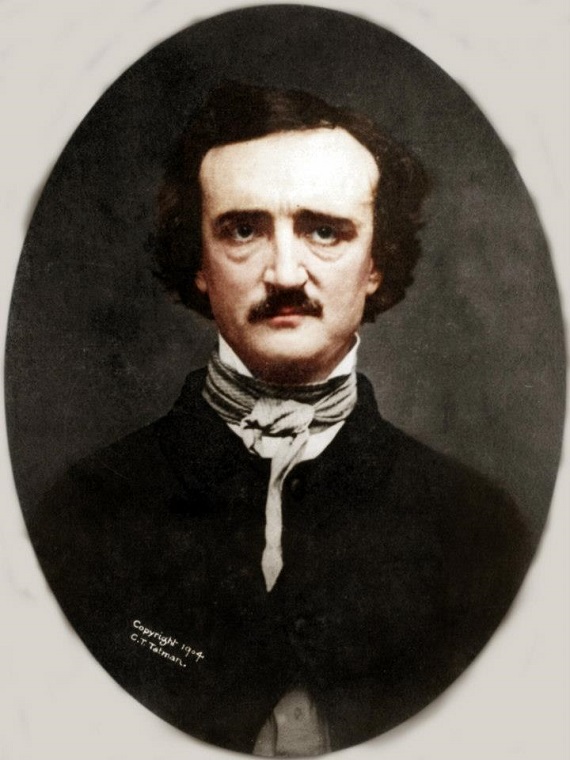
Edgar Allan Poe secured a permanent place among world authors as
father of the short story, creator of the detective story, and/poetic
genius. While he has an international reputation, Poe consciously
identified himself as a Southern writer.
Poe may not often come to mind as a Southern writer because he did
not write about the South the way Simms or, later, Faulkner did.
Philosophically opposed to the use of literature for didactic purposes,
Poe did not make the South the object of his writing. Nonetheless, his
stories resonate with the attitudes and interests one might expect from a
young Virginia gentleman educated at the University of Virginia and
West Point.
His sojourn in South Carolina had a subtle influence on the setting
for many of his stories and poems. The sea, the marshes, the deep
semi-tropical forests hung with Spanish moss, the forbidding swamps, and
the narrow causeway approaches to isolated plantation manors formed the
setting for such stories as “The Gold Bug,” “The Oblong Box,” “The Man
that was Used Up,” “The Balloon Hoax,” “The Fall of the House of Usher,”
and “Annabel Lee.” Poe also pioneered in the introduction of black
characters in American fiction.