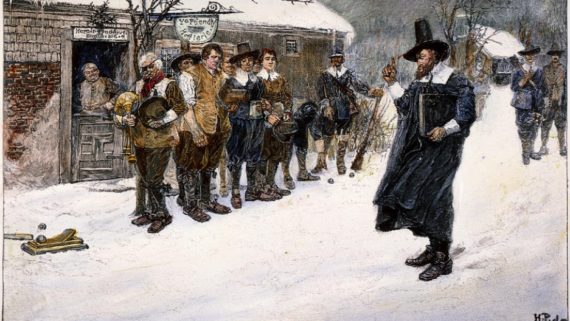
“Religion, taking every mortal form
But that pure and Christian faith makes warm,
Where not to vile fanatic passion urged,
Or not in vague philosophies submerged,
Repulsive with all Pharisaic leaven,
And making laws to stay the laws of Heaven!”
South Carolinian Henry Timrod penned these words in February 1861 at
the meeting of the First Confederate Congress at Montgomery, Alabama.
Many regarded Timrod as the “poet laureate” of the Confederacy because
his evocative works potently blended lyrical composition with patriotism
for
his nation, the South.
In “Ethnogenesis,” this teacher, tutor, and devout Anglican boldly
describes a people who self-proclaim superior sanctity and feel divinely
ordained to impose their will by force, drawing the comparison of the
ancient Pharisees to Yankees. But just exactly how did they get there? I
began heading down this historical rabbit hole in “
A City Upon a Hill,” so let’s dig a little deeper, shall we?