
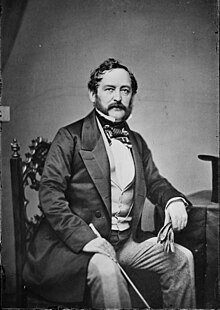
Edouard de Stoeckl
served as Russian Minister at Washington during the War between the
States, having first come to this country in 1841 as an embassy attaché.
He placed the blame for John Brown’s murderous rampage in 1859 on the
agitation of New England abolitionists. At the time, Stoeckl informed a
Russian colleague that….“John Brown was proclaimed from the very roof
tops [in the North] as the equal of our Savior. I quote these facts to
point out how far Puritan fanaticism can go. Little by little the
extreme doctrines of New England have spread throughout the land.”
Bernhard Thuersam, Chairman
North Carolina War Between the States Sesquicentennial Commission
"The Official Website of the North Carolina WBTS Sesquicentennial"
Russian View of Northern Manpower Problems:
”Stoeckl persisted in his belief that the North could never subjugate the South. The Union, he felt, could not endure. he was sure it was divided forever. “In my opinion, the permanent separation of the North and the South will be the inevitable consequence of the American crisis. It is difficult to witness events without being convinced that a return to the old system is impossible.”
”Stoeckl persisted in his belief that the North could never subjugate the South. The Union, he felt, could not endure. he was sure it was divided forever. “In my opinion, the permanent separation of the North and the South will be the inevitable consequence of the American crisis. It is difficult to witness events without being convinced that a return to the old system is impossible.”
A
born aristocrat, Stoeckl blamed the plight and tragedy in which the
nation found itself on the “ultra-democratic system.” He pointed out
that “only a handful of demagogues were able to accomplish this work of
destruction. “ He never ceased deploring the “rule of the mob.” He hoped
the north would accept the inevitable and seek cooperation with the
South. The sooner the bloodshed could be ended the better for all
concerned. He never overlooked an opportunity to offer his services as a
conciliator.
With Washington again in danger of attack, “General Halleck has been ordered to Washington to take charge of military operations.” Stoeckl wrote that Lincoln was experiencing great difficulty in replenishing the depleted military ranks. “The government has been compelled to offer a premium of twenty-five dollars a man.” Later he reported that premiums up to fifty dollars have been offered, yet there are few volunteers. Two weeks later, Lincoln issued another call for volunteers, with premiums up to three hundred dollars.
“Mr. Lincoln told me himself one day that in case of necessity he could count upon two or three million men. Experience has demonstrated that such estimates are inaccurate….At the outset the armed services absorbed the adventurous types, the poor, the unemployed laborers and the foreigners who filled the large cities. Not many of these classes remain. The new recruits must come from the farmers, businessmen and, in general, the prosperous classes who are opposed to the war.
Those who volunteered at the outset never dreamed of the dangers and privations which awaited them. It was generally believed that the mere presence of the Northern army would coerce the South into rejoining the Union. The ever-increasing number of mangled, sick, crippled or maimed soldiers who have returned to their homes has opened the eyes of the Northerners to the horrors of war. Men no longer volunteer for military service. Bonuses of $250 to $300 are being offered to volunteers without spurring enlistments. As a result, the
government was forced to resort to conscription. But it is doubtful if the government will succeed in recruiting the number Lincoln has fixed in his call. General Halleck, now in command of federal forces, admitted to me that not more than 300,000 to 350,000 men can be recruited, the majority for a term of nine months….”
When the House of Representatives passed a bill authorizing the President to arm 150,000 Negroes, Stoeckl reported that “the Democratic Party regarded this measure as humiliating for the nation, since it was an admission that an army of a million men cannot win without the help of some 100,000 Negroes”: [Stoeckl continues] “Mr. [Thaddeus] Stevens, the author of this measure, said that the federal army scarcely numbered 500,000 men under arms; that half these troops were scheduled to return home soon since their term of service expired next May; that volunteers are no longer enlisting; and that conscription was so unpopular that the government hesitated to invoke it again.”
With Washington again in danger of attack, “General Halleck has been ordered to Washington to take charge of military operations.” Stoeckl wrote that Lincoln was experiencing great difficulty in replenishing the depleted military ranks. “The government has been compelled to offer a premium of twenty-five dollars a man.” Later he reported that premiums up to fifty dollars have been offered, yet there are few volunteers. Two weeks later, Lincoln issued another call for volunteers, with premiums up to three hundred dollars.
“Mr. Lincoln told me himself one day that in case of necessity he could count upon two or three million men. Experience has demonstrated that such estimates are inaccurate….At the outset the armed services absorbed the adventurous types, the poor, the unemployed laborers and the foreigners who filled the large cities. Not many of these classes remain. The new recruits must come from the farmers, businessmen and, in general, the prosperous classes who are opposed to the war.
Those who volunteered at the outset never dreamed of the dangers and privations which awaited them. It was generally believed that the mere presence of the Northern army would coerce the South into rejoining the Union. The ever-increasing number of mangled, sick, crippled or maimed soldiers who have returned to their homes has opened the eyes of the Northerners to the horrors of war. Men no longer volunteer for military service. Bonuses of $250 to $300 are being offered to volunteers without spurring enlistments. As a result, the
government was forced to resort to conscription. But it is doubtful if the government will succeed in recruiting the number Lincoln has fixed in his call. General Halleck, now in command of federal forces, admitted to me that not more than 300,000 to 350,000 men can be recruited, the majority for a term of nine months….”
When the House of Representatives passed a bill authorizing the President to arm 150,000 Negroes, Stoeckl reported that “the Democratic Party regarded this measure as humiliating for the nation, since it was an admission that an army of a million men cannot win without the help of some 100,000 Negroes”: [Stoeckl continues] “Mr. [Thaddeus] Stevens, the author of this measure, said that the federal army scarcely numbered 500,000 men under arms; that half these troops were scheduled to return home soon since their term of service expired next May; that volunteers are no longer enlisting; and that conscription was so unpopular that the government hesitated to invoke it again.”
“In
spite of all these [Northern] disasters, the federal government refuses
to modify its policy with regard to the army. All the generals are
politicians. McClellan is the only exception, so he has been removed
from command. Burnside, Pope and Hooker owe their positions to their
political connections. As for the division and brigade chiefs, they are
for the most part lawyers and journalists whose only merit is that they
made some contribution to putting the present administration in power.”
(Lincoln and the Russians, Albert A. Woldman, World Publishing Company, 1952, pp. 191-192; 196-197; 201, 205-206)
(Lincoln and the Russians, Albert A. Woldman, World Publishing Company, 1952, pp. 191-192; 196-197; 201, 205-206)


